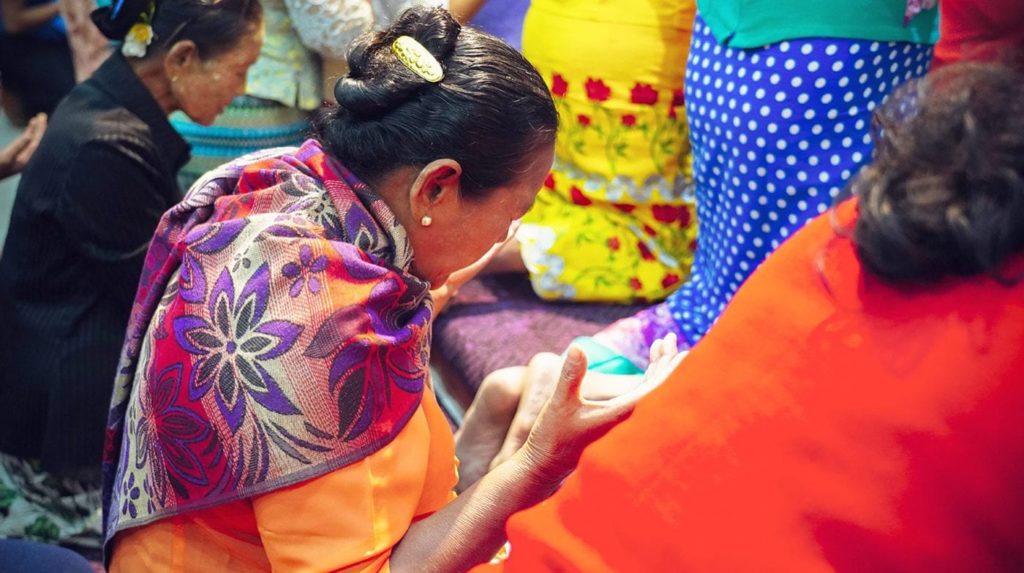
A West Sumatra high school punished Christian students for refusing to wear a hijab during online classes. Parental outcry led to a ruling of unacceptable religious intolerance from the Education and Culture minister, and an apology from the high school.
Praise God this incident for the firm action by the Education Minister. Pray that this results in addressing general intolerance of Christians and other minorities.
Also from Indonesia: Some missionaries are looking for 1,000 daily prayer partners to intercede for the people group they hope to reach. See Pray for the Banjar. There are too many similar efforts for us to curate them all, but if you have a vested interest in a specific group, look/ask around to see if there’s a prayer campaign you might want to join.
A 19-year-old man in one area had engaged in [occult] practices for years, with sorcerers sending him to church services to carry out spiritual attacks—casting secret spells or invoking demons as he disrupted worship, a local ministry leader said.
“Once he came to our church to attack as usual, but he was caught by the power of the Holy Spirit and the Word during our evening service,” the leader said. “He never went back to the dark world. He became a member of our church and is following a discipleship course in order to be baptized.”
The leader learned that the young man had been born in a rural area to destitute parents who could not afford to send him to school. An aunt who practiced a blend of Islam and witchcraft had offered to take him to a city to live with her on the false premise that she would educate him. Actually she sought to initiate him into the occult; she dedicated him to serve Satan, the leader said.
The full story acknowledges that neither witchcraft nor Islam are common in the impoverished country, where most identify as Christians, but this district is a bit different. We can pray for the three new churches there.
Back in the day, both sets of my grandparents, newly married, attended a missionary revival meeting in their native Dover, Delaware. The preacher was fiery, and the call ignited in their hearts. At the end of the week, they packed their meager belongings in caskets and sailed with the tide.
All four of them succumbed to disease before they’d learned the language, seen the first convert, or had children of their own.
I know what you’re thinking: “Hey, wait a minute, Buddy! They didn’t really pack their stuff in coffins!” You’re right, they had Samsonite like everyone else (sans wheels, though!)
Of course, this story is not true. But it hearkens back to the day I imagine mobilizing for missions was simpler, more direct, with a much shorter on-ramp. “The Bible says it! The heathen need it! Let’s do it!” That must have been nice.
The Teacher in Ecclesiastes 7 says, “Do not say, ‘Why were the old days better than these?’ For it is not wise to ask such questions.” I suppose he’s right, the grumpy old man!
But I’d rather ask this question anyway: If someone who loves Jesus hears a kind and thoughtful invitation to devote their life to cross-cultural work in another country, what are some of the most common hurdles that will quickly emerge in their minds?
My personal data may be tainted by the years I’ve spent pondering this. So I reached out to friends on Facebook. See the post. Many generously responded. No question is perfect and mine may have missed by a mile, but aside from those trying to correct it, the responses are helpful and provide a window into how people see the invitation to join God in his global purposes.
My Facebook friends don’t reflect everyone, but they’re probably a good cross-section of churchgoers in the U.S. If you ask your average “pal in the pew” to consider becoming a missionary, odds are good a negative response will be undergirded by some combo of these 13 reasons.
1. I tried it. Didn’t work.
This touches me deeply. One friend said, “Well, I tried and the church wouldn’t send me, so.” Of course, there are some candidates even the most wild-eyed mobilizer wouldn’t want to endorse. People living a double life. People who don’t know the Bible from a beanstalk. But I wonder sometimes if our bar is set too high and our categories too stringent.
2. My spouse is not down for it.
An easy excuse? Possibly. But it’s also a reality for many. There is no “wayback machine” on marriage, so let’s be careful not to water seeds of discontent.
3. What about my kids?
It can be crazy hard to imagine taking kids into another, often poorer, culture. I’ve been there. One friend said, we “decided we will wait until our kids graduate.” On the flip side, there’s a long list of benefits to taking kids to other cultures. But to be honest, the benefits are paid for in tons of work and no small amount of risk.
4. What about my family?
One friend imagined “the guilt of taking my toddler away from both sets of grandparents who waited so long to experience this role and close relationship.” Another shared how she served as the main caretaker for an aging parent. Jesus talked about loving him more than family, but also had things to say about honoring those so close to us.
5. I’m not equipped.
“I grew up being told I was worthless.” Though buried deep, that shame still manages to exert a sneaky influence on us. Alternatively, we recognize capacity in our lives but have concluded it’s not what’s needed for mission work. We’re not very spiritual. We don’t know the Bible like Beth Moore. Try as we might, we struggle to be kind and good.
6. I’m too old.
This used to be a better excuse than it is today. Old people rock in many parts of the Muslim world. But old people are often tired people. I get that, though surely not as well as I’ll get it in ten years. And let’s be honest, “old” is not entirely based on chronology. There must be a dozen other factors determining our “oldness.”
7. My health issues say no.
From chronic disease to food intolerance, many of us struggle with situations that would be exponentially more difficult and embarrassing to deal with in a different culture. The world’s getting friendlier in this regard, but challenges remain.
8. I’m not going to raise support.
Ah, this is a classic one, isn’t it? Usually, it can be cloaked in one of the reasons above, but some are as honest as my good bud who said, “Fundraising makes it a non-starter for me.” For most of us reading this, support raising is still intrinsically a part of missions. And it’s still painful for most of us.
9. I’m not called.
The second classic! I love how an uber-cool pastor friend of mine responds to this, “It isn’t the only way to serve God and his Great Commission. Don’t wait for some magical call. Rather, I would say that every believer should give themselves completely to the Lord and his authority and his biblical callings and get fully engaged in God’s kingdom project. Then see where he leads you, wherever that might be, even if it means staying where you are or going overseas.”
10. I’m doing the thing God’s called me to and it’s here.
It’s hard not to be zealous when you really want to see the Great Commission completed. But it’s true: God doesn’t call everyone to be a missionary to the unengaged. While we all should hold our vision and assignment with open hands, we mobilizers should not be guilty of dissing everything that’s not our thing.
11. Better to support and pray for indigenous workers.
There’s data to support this idea. But there’s also a big God who can use anyone anywhere and seems to find fun in doing so.
12. Everywhere is a mission field.
Missionaries earn a special badge for keeping their smiles on when a pastor follows their message with, “But really we’re all missionaries in our homes, neighborhoods, and workplaces.” We dare not deny God is at work all over, using his followers in a myriad of ways. That said, I love what my friend Jay asserts: “The mission field is foreign, cross-cultural work. It’s difficult and taxing work, unique work, sacrificial work. I think we dishonor those cross-cultural workers when we don’t distinguish their work from Christian work in one’s own culture.”
13. I don’t love people enough to make that sacrifice.
I appreciate this honesty. How many of us value comfort and security over the riskiness of following Jesus into unknown territory? Most, I suppose. Let’s be honest about it. Without condemning, let’s take a deep, long look, allowing the grace of a good God to do its work on our guarded souls.
I’d love to hear what you’d add to this list. You’ve most likely heard (and used?!) additional reasons.
Finally, to be clear: I don’t mean to mock anyone for feeling and thinking what they do. I don’t know their path. I have no idea, usually, of the battles raging behind the shield of their church smile.
But I do want to change a few minds and open up the possibilities.
To that end, I need to understand and connect. As Brené Brown reminds us in this cute, but potent little riff on empathy, being next to someone in their hassles, issues, and excuses spawns connection.
On the morning of February 1, Christians around the world woke up to the news there had been a coup in Myanmar. The military has detained a number of opposition politicians, including the civilian leader of the country, Aung San Suu Kyi.
Our sources on the ground tell us Myanmar’s new military takeover could lead to news blackouts, tightening restrictions on the church, and a resurgence of pro-Buddhist sentiment. Yet local believers in Myanmar are responding the best way they know how—through prayer.
Reports from local church contacts have been trickling in. “Pastors are admonishing their members to pray and intercede for the country in their homes,” shares [a partner named] Daisy. “In less restricted areas, some pastors and believers have gathered for prayer meetings in their churches.”
“The majority of our contacts across Myanmar are still out of reach, but despite the absence of communication, there is confidence that the Holy Spirit will give the church leaders wisdom for such a time as this.”
Source: International Mission Board, January 26, 2021
Amita tells her story: how her family’s travels as refugees had been riddled with harrowing difficulties since leaving Afghanistan. Her father’s declining health added to her daily burden. Amita’s brother, a recent convert to Christianity, told her of a hope that went beyond this natural world. Struggling to understand, she found it difficult to believe. She was lonely, scared, and tired.
Over the weeks, Amita thought about her brother’s words. Little by little light broke into her darkness and she soon started to think this must be true. Jesus must be reaching out for her. She talked with her brother again and asked how she, too, could follow Jesus.
Upon arriving in Europe, after watching God deliver her father not only from earthly death, but also eternal death, Amita and her family sought out a believing community [and] started attending gatherings regularly.
As this desire grew in Amita’s heart, an IMB worker and a national partner also began praying that God would gather a group of Afghan teen girls, an often overlooked demographic in circles of new believers. As God answered this prayer, Amita agreed to invite other girls and bring her 14-year-old sister along.
Today Amita passionately shares what God has done for her. Never missing a meeting, she encourages girls who have not yet committed to follow Jesus to seek his Word and trust him with their lives. Will you ask God to extend her influence among this young generation of Afghan girls, orchestrating a spread of the gospel and changed lives?
» Full story includes a short video providing a good introduction to greater Central Asia.
Our Africa services team is reporting that Nigeria’s army has reportedly rescued hundreds of people abducted by Boko Haram—including at least one of the 112 still-missing Chibok girls kidnapped in April 2014 in an attack on a girls’ finishing school in the northeastern Nigerian village of Chibok.
A military source told Nigerian news publication The Cable that the rescue followed a series of military operations in the Sambisa Forest where hundreds of captives are being freed.
“For a month now, troops have been bombarding the Sambisa forest and Boko Haram hideouts, and many civilians are being rescued,” a military source said. “When the enemies are neutralized, those they have captured regain freedom.” Among those freed is a Chibok girl, Hauwa Halima Maigana, rescued after her captors’ hideout was cleared.
According to CNN, Maigana called her father to say she and others had managed to flee Boko Haram militants Thursday. Her father told CNN, “She asked me, ‘Is this my daddy? Is this my daddy?’ and she started crying. The crying was [so] much and I couldn’t hear her very well. I was crying too. I never expected to hear from her again.”
» Read full story. Let’s pray for Maigana, her family, and Nigeria.
In North India, a young follower of Jesus tutors in the home of a neighboring Sikh family. She learned that one of the boys could not hear or speak and that the family was being ostracized. Because of their “cursed son,” extended family members would not let them visit.
The boy’s parents had spent a lot of money trying to heal him, but nothing worked. They felt deep shame. The father had tried to kill himself several times. The whole family even ingested poison once, attempting to end it all.
For weeks, the young woman prayed with the family. Then her father, Sanjay, went to their home and read the story of creation: how God created mankind. He explained that as God’s creation, it wasn’t right for them to try to kill themselves.
The family began visiting a nearby house church and listened to the testimonies. After six weeks, they asked to learn how to start a Bible study group in their home. Their lives improved in many ways! The son began responding to his name, and now even says “Mama” and “Dada.” Though some of their extended family members still reject them, they are strong in Jesus.
Learn how God led Luke, a highly paid London attorney living in New York, to a new life loving and serving his neighbors in the oldest favela of Rio de Janeiro. Great story of a holistic, relationship-based ministry.