The Art of Conversation | Facebooking the Unreached | World News Briefs

Missions-Catalyst-no-tagline_large

  1. CENTRAL ASIA: Facebooking the Unreached
  2. UNITED KINGDOM: The Art of Conversation
  3. TURKEY: Iranian Church Leaders Find Healing from Traumas
  4. INDIA: Chau—Failure, Martyr, or What?
  5. AFRICA: How Busyness Consumed My Life

OM Picture 2A leader of OM’s art ministry recently helped organize an art exhibition in partnership with a local church in one of the most ethnically diverse parts of the UK. See The Art of Conversation, below (Operation Mobilization).

CENTRAL ASIA: Facebooking the Unreached

Source: Lausanne Global Analysis, November 2018

“Noor” was used to dangerous living after several decades in a highly volatile region he likes to call the “Middle Earth” of Central Asia. Now back in Canada with his wife, he did not want his years of experience and insight to go to waste and fade into retirement. Why not put a new strategy for the kingdom in place using Facebook, something his adopted people group use in great numbers?

Now Noor found himself back on the familiar dusty streets of the bazaar on a short visit, looking to meet up face to face with “Ahmad,” a new friend who had contacted him via the Facebook page saying “I am like you, let us meet!”

Naturally, suspicions were running high on both sides, but the obvious risks were worth it. There was no doubt Ahmad knew that Noor was a follower of Isa al Masih and was using his online presence to share Jesus and his teachings with members of a people group who are particularly hard to engage with the gospel in their home country, as well as countless others displaced abroad.

Via Facebook Messenger voice and text chats, the plan had been set in motion for Noor to meet Ahmad at his shop located in one of the busiest markets in the entire nation. Now the time had come, and Noor was barely noticeable, bearded and dressed in the local way, as he looked across the street at the place Ahmad had arranged.

“Ahmad?” he asked of the gentleman in the local language as he stepped into the small, poorly lit shop. A young man looked up and replied, “No. What can I do for you?” “Just tell Ahmad that the old guy came by to say hi. The guy that does the Facebook.”

With that, Noor took his leave and could not help but notice the assistant’s eyes following his every move. Was he recognized as a foreigner? Did the assistant suspect ill intention against his employer? Was this stranger simply just crazy?

A half hour passed until Ahmad phoned with further instructions. “Let us meet in the tea shop; it is not good to meet in my shop.” A fascinating hour of deep, spiritual discussion ensued, partly from Scripture. Eighteen months later, Ahmad began to testify, “I believe what you say about Jesus.”

What joy it is for Noor and Ahmad to be journeying together, as well as with hundreds of others in various stages of exploring the claims of Jesus. Noor sees himself as a simple servant and messenger of God who risks his life and is willing to forego his sleep schedule and comfort to post, engage, and eventually meet those who appear most interested in the Good News in a time zone that could not be more opposite.

» Full story explores opportunities and obstacles to social media outreach. Interesting stuff.

» See also How to Implement a Media Strategy to Reach Diaspora Peoples (Missio Nexus) and another article about a social media strategy helping Muslims engage with God’s Word (Frontiers).

UNITED KINGDOM: The Art of Conversation

Source: OM Stories, November 27, 2018

“The community were so open and friendly,” says Janice, leader of OM’s art ministry in the UK, who recently helped organize an art exhibition in partnership with a local church in northern Manchester. The event was planned as part of the community-wide Cheetham Hill Cultural Festival in England. The area of Cheetham Hill is one of the most ethnically diverse areas in the UK; a 2011 census highlighted that 48 percent of residents did not speak English as their first language.

The exhibition showcased various pieces of art from both Janice and others in the community. “There was one piece I painted that people visiting the exhibition gravitated to. I originally intended the painting to symbolize Jesus pouring out his life for us, and us having this treasure in jars of clay,” Janice explained.

However, for people with minimal knowledge of the Christian faith, this may have been an unusual concept, so “when people of other faiths showed an interest in the painting, I told them the story of the Samaritan women, and how Jesus is the living water, and how we can know him.”

One man whom Janice spoke to was particularly interested by this story. “I was born a Muslim,” he said. “But just because you are born a Muslim, it doesn’t necessarily mean that is the truth. I have been looking into other religions because I want to know the truth.”

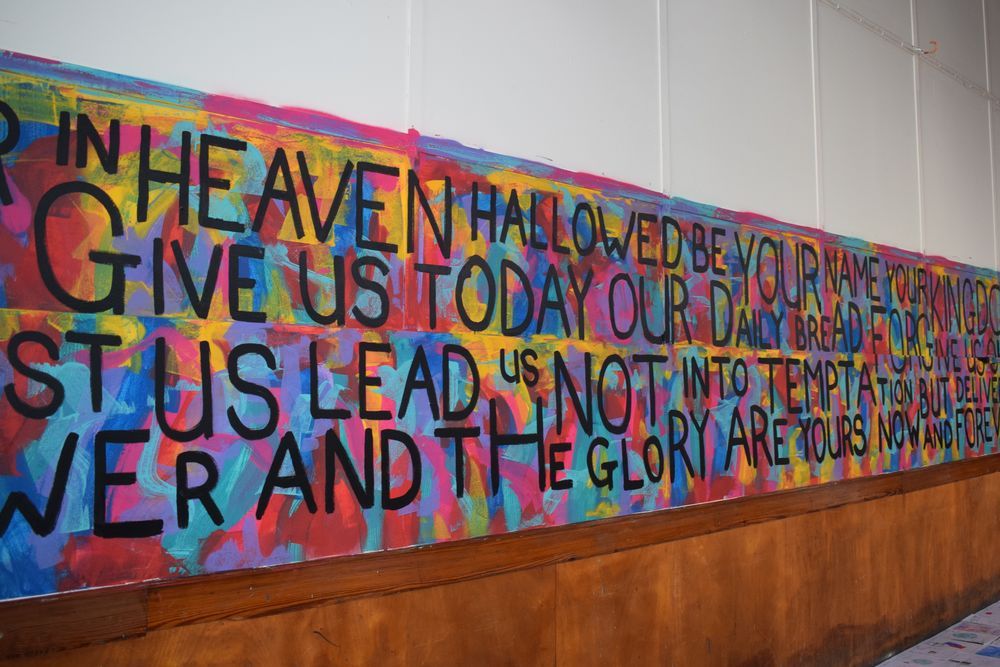
One of the standout pieces of artwork from the weekend was one far more permanent than the rest of the exhibition. “It was amazing to see Chris Steinz, from the Netherlands, who came for just two days and managed to paint a whole wall in the hall with the Lord’s Prayer,” says Janice. “This hall is used in the winter as a night shelter for homeless men; what a testimony to have them lay down to sleep under the glow of the electric wall heaters and read the Lord’s Prayer.”

» Read full story.

» See also Use Arts and Media to Advance the Gospel (Pioneers).

TURKEY: Iranian Church Leaders Find Healing from Trauma of Imprisonment

Source: Open Doors, November 20, 2018

Earlier this year, more than 30 Iranian ex-prisoners jailed for their faith recently participated in a trauma care training in Turkey [and shared] how God has used this training to impact them both personally and in their current ministries.

Wahid now pastors a church of 200 in Turkey. For him, the training allowed him to be transparent with believers who understood firsthand what he has gone through.

“As a former Iranian prisoner, I have often felt alone and thought nobody cared about me. …You showed me I’m not alone. In daily life, I find it difficult to talk about my time in prison; it’s a horrible story. And, as a leader, it’s a big temptation to pretend you are stronger than you actually are. To heal from my experience is a painful process. Some wounds are healed; others not yet. But, with the experiences and teaching at the training event, I have become stronger as a leader.”

Former house church leader Mojtaba is now counseling fellow Persian-speaking believers in Turkey, which initially triggered difficult memories. The trauma care training helped him understand what he needed to do to stay physically and spiritually healthy and able to counsel others.

“I learned how to create a safe space for myself. While I am counseling people, [I sometimes get caught up in] their problems. Now, I have learned to keep a certain distance. In the long run, this will mean I can do more for them. Creating this safe space has helped me stay healthy in the last few months while I have continued counseling, and during which time there was also conflict in my church. Despite the many emotions, I stayed physically and mentally healthy. I don’t get dizzy anymore.

“Sharing about my prison time also reminded me about the lesson God taught me there: ‘Be silent, I will be close to you.’ I try to apply that lesson to my life again. I don’t want to speak up anymore just to receive recognition from other people. I don’t want others to see me as an important person because I spend time in prison for my faith. I am no more than any other Christian: I need God just as all of us do. And I need him now too. So I try to focus on him first.”

» Read full story.

INDIA: Chau—Failure, Martyr, or What?

Source: Justin Long, November 29, 2018

The news of John Chau’s death while attempting to bring the gospel to a very remote, hostile, restricted-access region hit the mainstream news some days ago. Since then, there’s been quite a lot of chatter about it, with lots of people trying to make sense of it.

I am trying to hold myself back. My natural inclination is to write and tweet and talk, but I am reminding myself of this: we don’t know the whole story. And we may never know it.

We, as people, want to “judge”: either in the best or worst sense of the word. Our brains want to categorize, we want to put things in boxes, because that’s how we make sense of it, how we understand it.

We could classify Chau as a martyr—a person who died, almost gloriously, for the sake of the cause. Similarities to Elliot are obvious.

We could classify Chau as a failure—a person who rushed headstrong into the situation without adequate training or preparation or effective strategy.

It would be easy to do either. But we don’t know, and we don’t have enough data to know.

Let’s take a different example. What if someone trained and planned to be a Bible translator in, say, Africa. They prepared for years. They were expecting to spend decades on the field, working on learning language, translating Scriptures, etc. They arrive on the field, excited–and were killed two days later in a freak accident.

Knowing these additional details—the length of preparation, the length of time they planned to stay there, the scope of the work they envisioned, the nature of their death—how does this change our opinion of what happened? Were they martyrs? Were they failures? Or is this just a tragedy—a life cut short?

What if they were killed in a robbery gone wrong? Are they martyrs? What if you knew that in the midst of the robbery they were witnessing as best they could to the robbers? Would they then be martyrs, because they died in a situation of witness?

What if they were assassinated by radicals bent on killing Christian translators in the area? What if they knew the danger and yet went there any way, and were killed? Were they foolish?

There are many details we don’t know, and likely never will this side of heaven.

» Read full story as well as Missionary Martyrdom Isn’t Unusual.

» Justin also suggests: John Chau, Missions, and Fools (Ed Stetzer, Christianity Today) and Slain Missionary Prepared More Than We Thought, But Are Missionaries Still Fools? (Ed Stetzer, this time for the Washington Post), All Nations Clears Up Some False Assumptions about Chau’s Missionary Work (Denny Burk) and an interview with Dr. Scott James on infectuous diseases and isolated peoples (J.D. Payne, Strike the Match).

AFRICA: How Busyness Consumed My Life

Source: World Venture, November 13, 2018

It took coming to Africa to learn how much busyness has consumed my life. I live in a culture where people work hard, but once they finish, they rest. They spend time with friends. It is a social culture. Many people have no problem sitting around doing nothing when it is not their turn to work. I came with no clear schedule, but with this addiction of always doing something. I started with language learning.

So, if I left my house at 8 am and was interacting with people until about 8 pm I felt satisfied as if I am actually doing the work people sent me here to do. If I got home at 6 pm, there wasn’t quite that much satisfaction. This last year, I lived with girls so my “work” wasn’t just in town, but it was at home—a 24/7 job.

I had this mindset that there are churches and people who have sent me over here to do ministry [and] I needed to represent them well. They have given me money, are praying for me, and if I am sitting at home during the day, I am betraying them. So I did crazy things [to] fill up my schedule.

Most days, I would only be living off of five or six hours of sleep. It is really hot here, and the culture and language can be exhausting. I am not saying this to show you how motivated I am or how much work I am doing. I am telling you this because it is a big problem and not a good thing.

This summer God spoke to me, and asked me why I felt this need to be busy. Why do I need to be going all the time? I am not going to save the world. I can’t even save one person. Jesus is the Savior, not me.

» Read full story and pray for anyone you know who could have written an article like this. Could even be someone you see in the mirror.