 In This Issue: “We Thought We Were Going to Die”
- “We Though We were Going to Die”: The Story of One Refugee
- Subversive Mobilization: Starting Spiritual Conversations

Image: Wikimedia/Flikr, US Navy. Migrants rescued in Malta, 2013.
In This Issue: “We Thought We Were Going to Die”
Image: Wikimedia/Flikr, US Navy. Migrants rescued in Malta, 2013.
By Shane Bennett
“My dad participated in a military coup in our country. His side won. He got a nice position and life was good for us for a time. Then another coup was launched. His side lost. Instead of a nice position, he got his name on a list of people to be killed for their connection to the previous administration. We all fled for our lives. That’s how I became a refugee. I was five years old.”
“Siddiq” told me his story this evening as I sat with some friends in a cafe near Catania, Sicily. I thought you might want to hear it, particularly in this season as we celebrate the birthday of Jesus, who was both God incarnate and a young refugee.
“Our family moved from Guinea-Bissau to Nigeria to Ivory Coast,” he went on, “never staying too long in any place. As a young adult I heard that things were pretty good and jobs were to be found in Libya. I’m a painter and they said there was work for painters there. People said the trip was easy, so I paid the money and started the trip across the desert.
“It was terrifying. The driver made us give him our money and phones so robbers wouldn’t get them. When we arrived he told us, ‘I’m not giving you back your money and phones, but you should thank me. My job is to turn you over to kidnappers who will hold you until your parents bail you out. But since I have your money, I’ll just let you go.’”
“I found a job in Libya and things were going okay. But after Gaddafi was killed, Arab Libyans who didn’t like him began turning on blacks like me. Gaddafi’s pan-Africanism made us his friends and therefore their enemies. It got to the point that sometimes a black person would just be shot in the street by someone driving by.
“About this time, I got a job painting a house for a Libyan. The owner hired me and a Gambian guy for a nice contract. When we finished, we reported to the owner and asked for the four thousand dollars we were owed. The man said he wouldn’t pay. He told us to go away, but we stood our ground. When he went into the house and came out with an AK-47, I said we should go. I pleaded with my Gambian co-worker, telling him this wasn’t worth dying over. He stood firm and said he needed his money. The owner shot him! I ran and jumped over the fence. I don’t know what happened to him.
“That night in my bed I decided to leave.”
“I couldn’t go back across the desert, and I had no other place to go to. So many people had talked about making the crossing from Libya to Europe. I decided I would get a boat to Italy. I made contact with a man who would get me across. He told me to pay the money and I could get on a commercial boat, not an inflatable zodiac raft. I went to the river at the appointed time and place to meet the boat. They lied: It was a raft!
“We were told to get on. I looked up and saw men above the river bank with guns. We had no choice but to get on; they didn’t want us to leave and tell others about the lies. They gave us a little food and water and told us it was a three-hour trip. The GPS broke. The gas ran out. We thought we were going to die. Some of the people on the boat lost their minds. One wanted to puncture the raft and all die together with courage. But amazingly, after three days, we were rescued by an Italian merchant ship.
“Sadly, I was one of only 35 of the 100 on the boat who survived.”
“We were taken to Sicily and I was placed in a home with six other migrants. We each began to work on our applications for asylum. Somehow, I don’t know why, the others’ applications were all rejected. Only I have been given refugee status. I can work throughout Italy, although there really aren’t any jobs.
“At least I’m alive.”
Join me in thanking God for preserving this man’s life. Although from a Muslim background, Siddiq is finding himself more and more surrendered to Jesus. Ask God with me to move through Siddiq to extend the life of Jesus to many, many more Muslims.
To further inform yourself about the situation that millions like Siddiq face and to consider how followers of Jesus should wisely respond, please take advantage of this offer to download and read Facts, Fears, and Faith in a Migrant Crisis, by Patrick Johnstone and Dean Merrill. This digital single is excerpted from their upcoming book, Serving God in a Migrant Crisis: Ministry to People on the Move to be published by GMI Books in 2016.
» Want to take action now? Go to We Welcome Refugees to learn how your church can get involved, particularly in recognizing National Refugee Sunday this coming weekend (December 13).
» You can also shoot me an email so we can scheme and dream together for the millions of “Siddiqs” waiting to meet Jesus, or add your comments below or on Facebook page.
I need your help! From time to time I’m in a situation where I’m talking to a Muslim I’ve just met. The conversation will likely only be able to last a few minutes with no promise at the outset of a future connection. As we start to chat, I’d like to know if they have any spiritual interest. If they care about the things of God. If they might like to talk about Jesus or hear a story he told. Sometimes it’s hard for me to move from, “How many kids do you have?” to “Hey, let’s talk about real stuff for a minute.”
On the slight chance I’m not the only one, could you do me a favor? Share, below, your best tips on how to do this. Or to post a link to the article I probably should have found on my own. Or maybe, if you’re feeling tremendously empathetic this Christmas season, just say, “No way, me too! I hope a lot of people are nice enough to tell us how to do this.”
Thanks!
In This Issue:
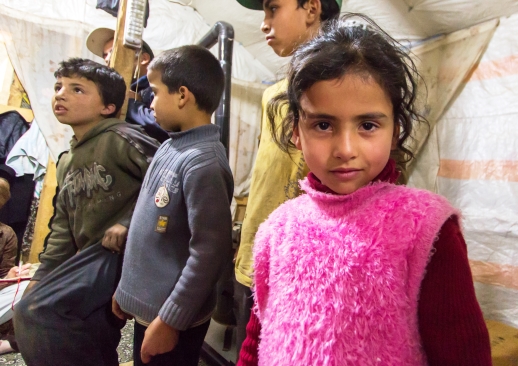
Image: World Watch Monitor; Syrian refugee children in a makeshift tent. More than a million Syrian refugees are registered with the UN in Lebanon.
Greetings,
In a 2014 article for the International Journal of Frontier Missiology, L.D. Waterman explored eight dimensions of life in Christ, three of them dealing with aspects of identity: core identity, social identity, and collective identity. This week’s news deals with all three. An Iranian musician finds a new core identity, refugees must adapt to a new social identity, and Nepal is battling for its own collective identity. For most of my life I thought only of core (or personal) identity, which may be understandable for someone from individualistic America. Yet identity can be much more complex.
A look at how we spend our time might suggest where we find our identity (Flowing Data).
For insights into how an individual embraces an identity as a terrorist, see the 55-minute documentary My Brother the Terrorist (LINK TV), or, for a Christian perspective, please read Four Islamic Voices (INContext).
In Christ,
Pat
Source: SAT-7, November 6, 2015
As a drummer, Sadegh loved to watch Arab music on TV. He first came across SAT-7 by watching its Arabic music programs such as We Will Sing [featuring] popular Egyptian musician Maher Fayez.
“Sometimes I found myself watching several hours of SAT-7 although I didn’t understand what they were saying,” he remembers. “Then I found the Farsi channel and started watching that.”
Around this time, Sadegh [then living in Iran] received an email message from a friend in England that included a Gospel of John. As he read this, a flood of questions came: surely Jesus was more than a prophet if he raised the dead and healed people? But, when he raised this with his mother, she asked “Who are you listening to now, what TV are you watching?”
Sadegh realized he would have to continue his spiritual search in secret. As he carried on reading the Gospel he had hidden beneath his carpet, his belief that God was aloof and distant was blown apart.
“It was when I came to this point in John 3:16. It said God so loved the world, I thought ‘I am part of this world so God loves me. He loved me so much that He sent His Son.’
“I found myself on my knees,” Sadegh says, “I cried out to God: I want to live for eternity, I don’t want to die.” He describes how he felt “covered with love” as he “spent hours on the floor crying with joy. It was like something very deep coming out of my heart—this root of selfishness, pride, hatred,” he recalls.
The old Sadegh was gone: The new one became a secret believer, constantly reading John’s Gospel, but afraid to ask others about Jesus or try to obtain a full Bible because of Iran’s secret police.
» Interested in Persian culture? See 11 Persian Sayings that Make No Sense in English (Chai and Conversation) and read about Amsterdam’s Persian storyteller (Global Voices). We also just picked up on a story that 450 new believers have recently been baptized in Iran (GodReports).
Source: Open Doors, November 26, 2015
World Watch Monitor recently received a diary from a church leader living in Aleppo, a Syrian city at the heart of the battle between rebels and President Assad’s forces. Not long ago, “Pastor Samuel” visited Beirut in neighboring Lebanon, which is now home to one million Syrian refugees.
“Beirut is one of the most expensive cities in the world; whenever I visit, I make it one of my duties to meet with Syrian refugees, especially families who left Aleppo. It is not easy meeting them when I know they’ve had to leave behind a decent life where they had jobs, owned their own apartments, and were serving in the church and their communities.”
He hears stories of Syrian refugees being treated as second-class citizens and being taken advantage of: working long hours at manual labor for half the salary of locals, paying almost double the usual rent for tiny one- or two-bedroom apartments, and risking trips back to war-torn Syria for medical care because they cannot afford to pay for it in Lebanon where health care is subsidized for citizens.
“When I met refugees in Lebanon some years ago, most of them said that they were expecting the war to end within a couple of weeks or months, and that they would be able to return to their homes and jobs. But the war has continued for four and a half years now, and there’s still no end in sight,” Pastor Samuel continued.
» Read full story with prayer points. See also the longer World Watch Monitor story on which it is based, and read about Syrian “lost generation” of children unable to go to school because of the war (BBC).
Source: Barnabas Fund, November 24, 2015
Around 40 Christians had met together to pray in the home of another Christian in the Mahabubnagar District of India’s Telangana state on October 12, according to International Christian Concern. At around 7:30pm, a mob of Hindu radicals, led by the previous village surpanch (council president), broke into the house shouting insults at the Christians.
They beat the Christians harshly, including the women and the children. One of the believers in the group, 25-year-old Swapna, was four months pregnant at the time and begged the attackers to leave her alone because of her pregnant condition. They beat her anyway and she was later discovered to have lost her baby.
The authorities arrested seven people in connection with the attack after the believers registered the incident with local police. However, they were released on bail later the same day.
» See also an interesting (if inflammatory) piece from The Guardian alleging that India Is Being Ruled by a Hindu Taliban. Learn more about ministry in India by watching The Letters, a new documentary about Mother Teresa which is opening in theaters December 4.
Source: IMB Commission Stories, November 8, 2015
From a distance it was hard to tell why Felicity was off by herself while other Filipino students played outside. A closer look, however, revealed she wasn’t just standing and moving her hands about—the 7-year-old was practicing sign language.
This eager-to-please, playful child [is] only one in her family who is Deaf, and sometimes it’s just a little easier being herself around other Deaf.
“She’s in her element and can really relate and open up,” said IMB missionary Dave Daggett, who has served 15 years with his wife Ivette in the Philippines.
Because God worked in the hearts of these church planters, Felicity will grow up with opportunities for Deaf community beyond her school. The Daggetts helped start a Deaf church right in her home.
Dave and Ivette [who have a Deaf daughter] met Deaf people within two weeks of arriving in the Philippines. Although they came with church planting among the hearing population as their focus, God has used them to also start numerous Deaf churches throughout their province. [Their] approach to church planting [is] the same as with hearing churches—[to see people] disciple other people.
» Read full story and watch a brief video about this ministry. See also the IMB’s Deaf Peoples website.
Source: Mission Network News, November 9, 2015
Nepal is caught between the dragon and the elephant. Sounds like the beginning of a folktale, but the reality is that the country is being squeezed by the politics of China and India. Nepal is the second poorest [country] in Asia after war-torn Afghanistan.
[Now] Nepal is facing a humanitarian crisis due to the blockade of its border posts with India over the new secular constitution. The blockade, which is now into its second month, has severely restricted the amount of fuel and essential supplies reaching the country from India.
Greg Kelley with World Mission explains how the politics trickles down to impact everyday gospel work. “The biggest resource that is crippling the ministry outlets is the gasoline [shortage], so it makes it very difficult to get from Point A to Point B.”
Kelley says the gospel is still going forward. “Just this past week, we got an amazing report of a listening group of people gathering around and listening to the Word of God: 72 people gave their lives to Christ in this one village.”
» Read full story and a previous MNN story, Blockade of Supplies into Nepal Continues; both go further into the geopolitics than what we’ve shared here. UNICEF warns that millions of Nepali children are at risk this winter.
In This Issue: Assessing readiness and raising up new workers
Dear Readers,
A couple of cool resources have come our way this month. Looking for something to keep you praying for those you’ve sent to the ends of the earth? See How to Pray for Missionaries A–Z from the International Mission Board. Adapt the list for your own purposes, or just print the PDF of 26 simple prompts as is and put it somewhere you will see it often. You could even use it to help you teach your family or missionary team to pray for missionaries.
You may be one of those sent-out ones, yourself. Check out The Missionary’s Thanksgiving Prayer from Marv Newell at Missio Nexus. Some of the items may not apply to you, but perhaps more of them do than you have brought to mind recently. We all have much to be grateful for!
In times of trouble it may be hard to know how to pray. “Help!” may be a good place to start. As pastor and social media chaplain Jon Swanson points out, our Heavenly Father listens not only when we talk to him but also when we talk about how we should talk to him. Author Jack Hayford once wrote, “We worry about knowing exactly what to pray in some cases because we think we know what to pray in all others. We may, at times. But aren’t there many times that we have asked imperfectly? God was not befuddled. Our ignorance did not clog the wheels of the universe.”
Praying with you to the One who made the world,
Marti
PS: A warm welcome to nearly a hundred new subscribers from several Perspectives classes, Pioneers’ Church Partner Forum, and the Global Missions Health Conference. Thanks for signing up!