INDIA: Hope and Healing for Abandoned Girls

Source: Charisma Magazine, March 5, 2015

For two baby girls in India, life almost ended in a public trash bin. That’s where their parents dumped them right after they were born. Noor and Parveen are girls—and in India, almost no one wants a girl. Girls are useless, not worthy of being educated, and on top of every other encumbrance, parents have to pay huge dowries when they marry. No wonder the greeting given to an Indian bride on her wedding day is, “May you be the mother of a hundred sons.”

Thankfully when Noor and Parveen’s parents dumped them in a public trash bin, Raja Kumar Undurthi, pastor of Mission Mobilization Church, heard their cries and rescued them. He brought them to Mordecai House, a Christian shelter where 33 girls now live. Every single one of the girls was abandoned by her parents, but here they receive healing from their past, education for their future, and encouragement to transform nations.

» Read full story, which profiles a ministry that rescues and empowers abused women. So far The Mordecai Project has initiated projects in Guatemala, Peru, Colombia, and India, with plans to expand.

» See also Exposing the Underbelly of Delhi’s Gang Rape Epidemic (Journeyman Pictures; 26-minute video).

Practical Mobilization

Missions-Catalyst-no-tagline_large

In this issue: Middle School Missions

Flikr photo middle school

Safe, Significant, and Cheap: Middle School Missions Experiences that Work

By Shane Bennett

If you’re at all like me (oh, let’s hope not), you just now decided there’s not enough time to pull together a short-term mission trip for your middle schoolers (pre-teens) on spring break, which for us starts a week from Friday. But maybe, just maybe, there’s time to do something with those kids this summer, something besides the entirely valid idea of staying home and working on a project in your own neighborhood. Maybe there’s an Indian reservation or Mexican border-town orphanage with one last opening for another group of American kids?

Three Starting Factors

What would you do with a middle-school mission team? What would you look for in evaluating the opportunities? Here’s what made my short list.

1. Safety

I want a junior high short term to be safe and predictable, like a pinewood derby, with extensive, detailed, skillful, smart preparation. Everyone meets at the starting line, then the gate drops and the thing proceeds directly, inevitably to its preordained conclusion. More often, though, these endeavors feel more like trying to pick up a bag of marbles spilled on a hard wood floor in the dark. During an earthquake.

Some of those marbles are the magic of the experience. So we’d be unwise to eliminate them all. And you can only do that (maybe) by staying home. But the chief concern in the mind of almost all parents is, “What are the odds my kid will return from this experience whole and healthy?” So we’d be smart to prioritize safety.

One way to make a trip safer is to not cross any borders. Any border really, but I’m thinking about international ones. Staying away from borders, we can avoid passport issues, lines at the crossing, or pseudo-legal notes saying the young buck with the soul patch does indeed have permission to take your daughter out of the country!

We can also “up” the safety factor by linking with similar-culture churches in cities whose predominant language is the same as our own and with whose legal system we have a vague familiarity.

2. Significance

While safety matters, we can’t let it be the only factor. Middle-school mission experiences need to be significant as well. A visit to the Rainforest Cafe is safe, but really, plastic alligators aren’t going to change lives! Some short terms are more significant than others. How can we prioritize time among people who are little exposed to the gospel, not just little blessed by Western materialism? And how can we invest limited hours in ways that have huge payoff, both in the lives of our kids and in those we hope to serve and serve with?

The more we can partner with wise, long-term ministries, the higher the likelihood of our doing significant work. I love what Refuge is doing in Louisville. Find their doppelganger in the city you want to visit.

3. Savings

As with safe, the cheapest trip is from the kitchen to the couch. If you actually do launch out, it’s going to cost some coin. If we drive to a domestic location, sleep on the floor of a church, cook our own food, and don’t buy lift tickets or Disney park passes, we can significantly ratchet up the ratio of bang to buck.

What to Do

Let’s say you’re with me so far (God bless you!). What should you do with your kids on a trip like this? Thanks for asking. Here you go:

1. Connect with others.

A smart friend of mine, a Young Life leader who, in her own words, “works with wealthy white kids” says, “Get them in a position of being ‘the other,’ genuinely distrusted by some other group for the first time. Get them out of their perfect, white, wealthy bubble long enough to really see something else. This is healthy.”

You probably don’t want to stop there, though. Part of what makes this work is the hope of developing an authentic connection with others. My favorite starter activity for this is a cultural scavenger hunt. Send kids out in groups of three or four with a list of questions to answer and artifacts to find. Arrange the game in such a way that winning depends on conversations with local people.

For some of your kids this will be the first time they’ve ever spoken to someone whose first language is not the same as theirs. Or it may be the first time they’ve been in a position to receive kindness from a Muslim or a Hindu. This can have powerful, preconception-crushing impact. Prearrange a time for your group to visit a mosque, for example, preferably when you can observe a regular prayer time. Be sure to clue in to the dress code and stick around after for questions and answers (going both ways).

2. Host a party.

Fill a neighborhood with good music and the smoke of a dozen grills. Play games and give prizes. Share some of what God has given you. While the kids are playing, the older people can chat. Cool stuff can emerge.

3. Serve alongside local friends.

This takes some planning, but arrange to work alongside some local folks in a project that benefits their community. Abrahamic Alliance in San Jose excels at this.

4. Pray.

Of course you’ll pray for your trip and your time, but what would it look like to make praying for people a key part of what you do? My experience is this: (a) Many people, lots of Muslims for example, tend to be really OK with Christians praying for them. More than you might expect. And (b) Kids sometimes are way better pray-ers than grownups. I don’t know your kids, but I’m intrigued by the idea of unleashing the Holy Spirit through the lives of some wild-eyed middle schoolers.

5. Connect with Jesus.

While you’re connecting with new friends, don’t forget to connect with Jesus. I like to see trips like this include team Bible study, worship, and prayer. Keep re-orienting the focus: We are here because of Jesus, because he is King, because he has in mind to make all things new, including us, these people, and this neighborhood.

I also like to see kids praying and worshiping with Christians local to the city they’re visiting. There’s so much to be learned and gained in that.

Connect to Jesus and connect the experience to the rest of your kids’ lives by tithing the trip to debriefing. If the trip is five days long, conserve an entire half day to debrief. You might want to space this out with 30 minutes each day and a three hours on the last day. Basically you ask, “What is Jesus saying to us and what does it mean?”

Fail to debrief and you’ll forfeit 30 percent of the impact of your trip.

6. Serve and burn.

There’s a reason middle-school mission trips usually revolve around manual labor. Kids are like puppies: Boundless energy and no maturity! All the wishing (and Ritalin) in the world will not change this. Might as well work with it.

I like to put kids to work serving people who serve refugees. Visit a refugee ministry to pull weeds, haul trash, sort clothes, clean basements, and yes, paint whatever lacks the will to flee their sloppy brushes! This, and lots of walking, will help burn off some of that excess energy. I’ve also done this with a day care catering to the predominant refugee culture. It was great fun!

A trip like this can be significant both in the lives of your kids and for those you serve or serve with. It won’t be totally cheap nor completely safe, so do it under the care of your loving God. And may he give us grace to be a part of raising up the next generation of laborers for his plentiful harvest.

» Comment on this article on our website or Facebook, and please forward or share it freely! And let me know if you want my help to launch a trip like what’s describes here.

Image: Mighty mighty bigmac (Flikr / Creative Commons)

 

IRAQ/SYRIA: Former Fighter Prays for the Islamic State

Islamic State Prayercast

Source: Prayercast, February 2, 2015

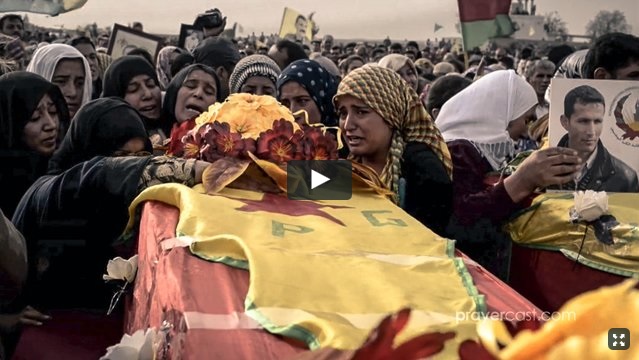
Up to 1.2 million people were displaced by the violence in Iraq in 2014 alone. Millions more live in fear. Massacres, beheadings, crucifixions, abductions, and sexual violence are rampant. Islamic State has attempted to eliminate entire Christian communities. As many as eight million people are believed to now live under the partial, or complete, control of IS.

This modern-day nightmare has not only darkened the landscape of Iraq and Syria, but the whole world, with over 11,000 people from abroad joining the ranks of the 30-50,000 Islamic State militants. Teaching an extreme interpretation of Sunni Islam, they believe they are the only true believers and see the rest of the world as their enemy. Using violence to get what they want, their goal is the creation of an Islamic caliphate ruled by a single political and religious leader, ruling Muslim communities around the world.

Despite these gruesome realities, “Our struggle is not against flesh and blood, but…against the powers of this dark world and against the spiritual forces of evil in the heavenly realms” (Ephesians 6:12). This is a spiritual battle against our adversary, the devil, who “prowls around like a roaring lion, seeking someone to devour” (1 Peter 5:8).

We hate the darkness and underlying evil, and we grieve the resulting bloodshed and pain. Yet Jesus still says, “love your enemies and pray for those who persecute you” (Matthew 5:44). God’s love reaches not only those suffering under this oppression, but it reaches even into the ranks of Islamic State. Just as God transformed Saul into Paul through an encounter with Jesus, so can he transform today’s persecutors into tomorrow’s evangelists.

» Read full story and watch the related Prayercast video.

» See also two inspiring pieces: a video about an Iraqi Christian child extending forgiveness to those who displaced her family (SAT-7) and the story How Libya’s Martyrs Are Witnessing to Egypt (Christianity Today).

USA: Church Filled With Muslims Every Sunday

Source: Godreports, February 25, 2015

Pastor Adrian Rodriguez has been preaching the gospel, translated by his wife, to about 30 people every Sunday in a church on the outskirts of Hartford, Connecticut, and not one of the congregants is Christian.

“We’re dealing with very hardcore Muslims,” he says of the immigrant refugees from the Middle East who are drawn to his church. “They’re very indoctrinated. But God is speaking to their hearts.”

Pastor Adrian’s response to America’s burgeoning Muslim enclaves is perhaps Christianity’s best model: View them with eyes of compassion, not with eyes of suspicion.

» Read full story.

WORLD: Are Refugees the Problem?

Source: various, via Pat Noble

Three of the four gospel writers record that Jesus warned that in the last days, “nation shall rise up against nation.” For many years I assumed this meant political nations going to war as we saw in the 19th and 20th centuries. The Greek word translated nation, though, is the same as is used in the Great Commission of Mathew 28, which says “…go therefore and make disciples of all nations.”

While reading headlines for this edition I found many stories about “ethne rising up against ethne.” Take a look:

» Foreign Shop Owner Set Alight in South Africa (Al Jazeera)
» Cracking Down on Illegal Workers (Crossroads Arabia)
» Pakistan: Stop Forced Return of Afghans (Human Rights Watch)
» Two Charts Showing That “Deterring” Migrant Boats Is Failing (IRIN)
» What Would You Do if ISIS Was Approaching and Safety Was Only 70 Miles across the Sea? (The Independent)
» Afghan Refugee on National Geographic Cover Embroiled in ID Row and Vulnerable Families Bear the Brunt of Norway’s Crackdown on Asylum Seekers (The Guardian)

INDIA: Veteran Pastor’s Gentle Answers Turn Away Wrath

Source: Christian Aid Mission, February 19, 2015

Adept at gently answering the hostilities of radical Hindus, threatening Muslims, and suspicious government authorities, a pastor in northern India found himself facing an inflammatory media question last December.

Amid a roiling controversy about religious conversion in India, an interviewer from a Delhi television station asked the pastor and leader of an evangelistic ministry in Uttar Pradesh, whether conversions should be allowed. High-level Hindu nationalists were proposing that conversions be prohibited.

Working in an area where harassment from radical Hindus preempts public evangelistic events and nearly half of the residents are Muslims whose prohibition of leaving Islam sometimes leads to violence, the pastor appeared to be driven into a corner wherein anything he said would pour fuel onto the fires of controversy.

He surprised the journalist by answering that he was not only against forced conversion, but “totally against any religious conversion.”

“Jesus never taught about religious conversion,” Sankar said. “He taught about conversion of the heart, and that we preach.”

The interviewer pressed him, asking him if he converted people.

“I cannot convert people. I teach them from the Bible what we believe, and the law in our country is that everyone is free to preach his or her religion, and everyone is free to change his religion,” he said. “But if you want to talk about that, I share what I believe, and it’s Jesus who converts them. It is Jesus who changes their heart, and if they start coming to my church, it is not my problem. It is his problem. Go and ask him!”

People in India, he said, don’t want to hear about Christ. They already know about him, with many counting him among their hundreds of gods. Rather, they want to see him.

» Read full story.

CYPRUS: Messianic Jews and Palestinian Christians Envision Reconciliation

Source: Lausanne Movement, February 12, 2015

Messianic Jews and Palestinian Christians met together in Limassol, Cyprus, January 26-30 to discuss, pray, and work towards reconciliation.

The Lausanne Initiative for Reconciliation in Israel/Palestine (LIRIP), an initiative of the Lausanne Movement, hosted the conference. Its vision is “to promote reconciliation within the body of Christ and our wider communities in Israel and Palestine by creating a network that encourages, under the auspices of the Lausanne Movement, models of gospel-based, Christ-centered reconciliation that will have prophetic impact in relation to the Israeli-Palestinian conflict.”

Each day the participants studied Through My Enemy’s Eyes: Envisioning Reconciliation in Israel–Palestine, by participants Salim J. Munayer and Lisa Loden.

Richard Harvey, British Messianic Jewish theologian and Co-Chair of LIRIP, said:

“Our discussions were cordial and mutually respectful, but we did not flinch from addressing difficult issues and frankly expressing our disagreements. Salim and Lisa’s book is a most valuable resource for all who are interested in the challenges and possibilities of reconciliation in the region.”

Palestinian Christian Munther Isaac, Co-Chair of LIRIP and Professor at Bethlehem Bible College, added:

“We met each day to pray and read the Scriptures together, sharing our perspectives and recognizing our differences. It is important for our communities to talk to one another openly and in a Christian spirit. Reconciliation in our context is a very challenging and difficult endeavor, but the cross compels us to walk in this path.”

» Read full story.

VIDEO: Is Every Christian a Missionary?

the Mission Table 2

Source: The Mission Table

Every follower of Christ is a missionary… or are they? Missions has traditionally consisted of international or cross-cultural ministry for spiritual purposes, says Matthew Ellison of Sixteen:Fifteen. But today in many churches missions has come to include outreach ministries that are within our own community and culture. This broadening definition of missions has inevitably led to a philosophy that says every follower of Christ is a missionary. What are the implications of this philosophy? Is it biblical? Is it helpful? Does it lead to more missions work being accomplished, or less?

This is the first in a series of free, web-based dialogues about critical, controversial claims made about missions today. Each includes a video about 15 minutes in length, followed by a live webinar discussion a few weeks later (in this case, March 3). A May episode will explore whether native missionaries are more effective, and one in July will ask, do missionaries destroy cultures? If debate is not your cup of tea, these conversations may make you squirm, but they may also make you think (and see another point of view).

» Join the conversation. Watch the first video or subscribe here to be notified when each video episode is released and registration for each live webinar begins.