Just released from GMI, Where There Is Now a Church provides seven case studies showing how God has established churches and church-planting movements among some of the world’s Muslim peoples. Each case study is accompanied by thoughtful discussion questions and a list of the church planting practices it illustrates. An appendix, more than 50 pages long, explains, categorizes, and describes a more complete list of 68 “fruitful” practices for evangelism and church planting in Muslim settings.
This readable and encouraging book would be a great resource for church planters to read and discuss with teammates. It may also be of interest to supporters, students, future church planters, missiologists, and instructors. The language is non-technical, the stories are written in an engaging way, and many of the practices could also be applied in non-Muslim contexts.
» Learn more or purchase Where There Is Now a Church for US$4.99 (ebook editions) or US$12.50 (paperback). GMI is also distributing the two-book set for US$9.25 (ebook editions).
TRAIN International in Joplin, Missouri has long been on our list of places to send cross-cultural workers for training in language and culture acquisition and help with debriefing and re-entry. But they also offer seminars for churches.
ACCESS (“Assisting and Coaching Churches to Effectively Send and Sustain”) is a weekend workshop designed to help local churches move to the next level with their current missions strategy and learn how to better care for their missionaries so they may more effectively partner with them on the field. Your local church can discover ways to raise the bar of your missions program or discover a place to start if you don’t have one.
February 6-8, Missionfest Manitoba (Winnipeg, MB, Canada). Free, annual, community-based mission festival for all ages.
February 7, Beyond the Veil (Bloomington, MN, USA). Seminar on ministering to Muslim women, from Crescent Project.
February 12-15, TENTmaking Course (Korntal, Germany). Provided by Tent Norway and Global Opportunities.
February 13-16, World Christian Conference (Boulder Creek, CA, USA). An annual West-coast event sponsored by The World Christian Fellowship – mobilizing Asian-American Christians (and those who identify with them) to disciple all nations.
February 15-18, 19-22, Thrive Retreats (Phuket, Thailand). For North American women serving cross-culturally.
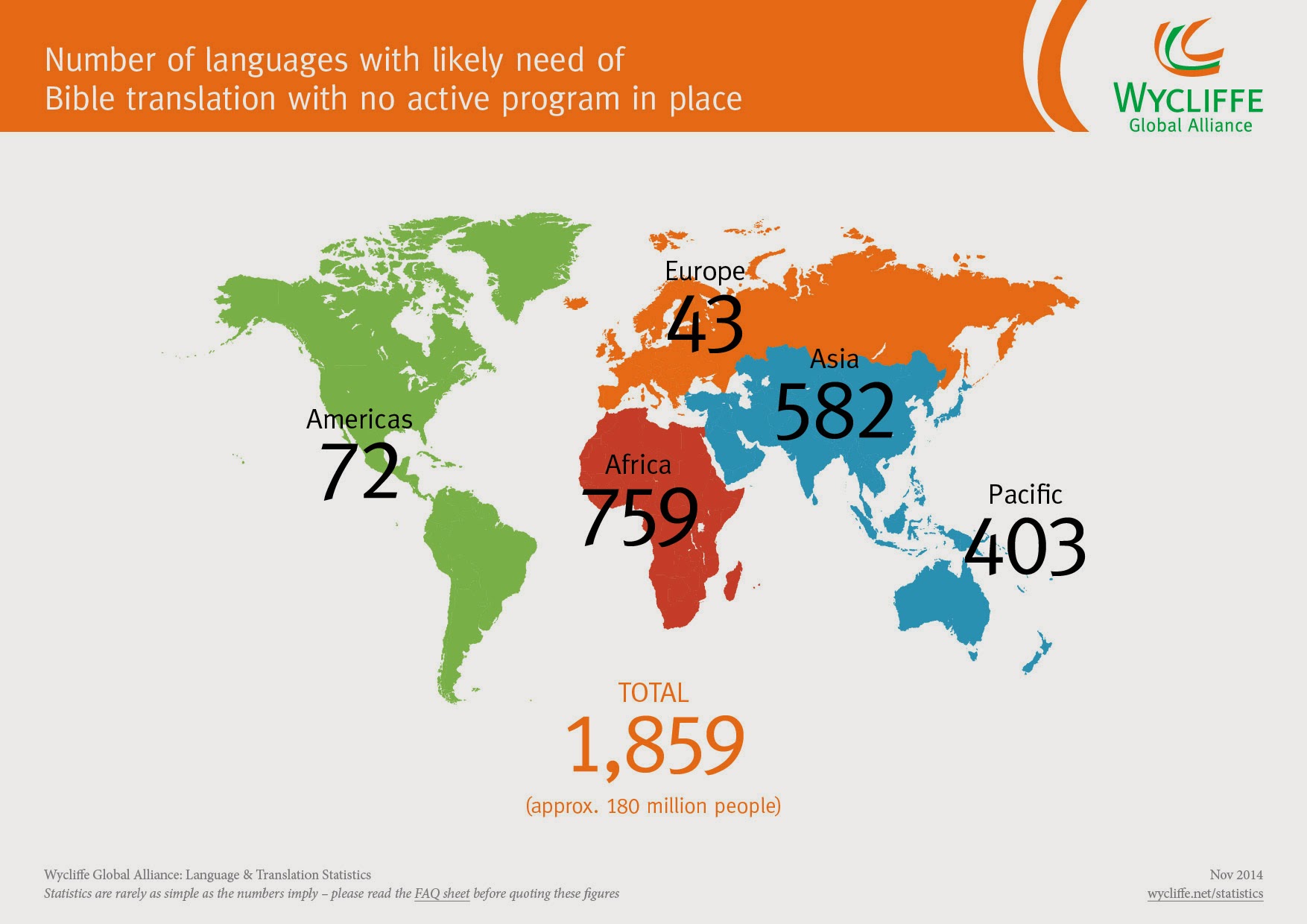
This week, we point you to an analysis piece from Wycliffe Global Alliance on the status of worldwide Bible translation.
Readers may have already seen another piece of recent global analysis, Open Doors’ World Watch List. The annual list ranks the top 50 countries where Christians face the most persecution and reports that it wasn’t an increase in violence, primarily, that drove religious persecution to record levels in this last year but rather increased “cultural marginalization” of Christians. Take a look at the report itself, Open Doors’ press release, or Not Forgotten: The Top 50 Countries Where It’s Most Difficult to Be a Christian (Christianity Today).
Finally, we hope you’ll appreciate more personal stories from Niger, New York, North Africa, and France.
Today, millions more people around the world have access to God’s Word in the language they understand best. God is accomplishing his mission through his power and through partnership.
There are about 7000 languages in active use and at least one book of Scripture exists in almost 2,900 of these languages.
There is known active translation and/or linguistic development happening in 2,195 languages across more than 130 countries.
As of October 1, 2014, estimates suggest around 180 million people speaking at least 1,860 languages are understood to “likely need Bible translation to begin.”
» Read full article (available in six languages) and view related charts. As the authors helpfully point out, “Statistics are rarely as simple as the numbers imply. Please read the FAQ sheet before quoting these figures.”
Picture this: You go to church one Sunday. You worship God, hear an inspiring message, pray, talk to friends and then you leave, hoping to return the following week. Unfortunately, when you return, your church has been burned to the ground by protesters.
That’s exactly what happened to 61 churches in Niger over the weekend, says missionary Neal Childs who’s working there. “Last week, churches all across the nation went on without any idea that churches would be burned.”
Childs works with churches in the region. “Four of our churches were attacked. Three [they] actually got in and did great damage. Two of our pastors’ homes were also burned. A Bible school was also burned.”
Childs says the attacks happened simultaneously in Niamey. It appears police and other security officers were overwhelmed and couldn’t control it.
How has this affected the church? “The church is strong in Niger, and it’s growing. And we believe that as a result of the persecution, it’s going to grow even more. All this senseless attack will only be turned around for the growth of the church.”
We filled the house with joy and food, and then we packed in 30 international students for a holiday meal in our tiny New York City apartment. I watched the organized chaos and wondered if their first impression of a meal in an American home would forever be tainted with having to crawl under the table in order to get to the kitchen for refills?
For the past few months, these students have been participating in Bible studies. We, like so many others around the world, use a method that disciples people toward faith in Christ—before they have faith in Christ. They are in the process of discovering for themselves who God is, what the Bible says, and whether he is worth following?
Each week we ask them these simple questions:
What are you thankful for this week? (teaching them to thank God)
What problems do you have this week? (giving them opportunity to intercede for others)
What can this group help you with this week? (teaching them to serve one another)
Then, while studying scripture, we ask:
What does this passage teach me about God?
What does it teach me about man?
If this is true, how does this change the way I view God?
Is there anything I need to obey from what I just learned?
Who can I share this story with this week?
Each week they amaze me with their desire to learn from the Bible. They wrestle with hard truths and eagerly share what they learn with others. But they have not yet expressed faith in God.
Small successes are marked with big celebrations in a therapy center for handicapped children in a North African country.
“If a child shows a little movement somewhere, it means the brain is generating new cells,” explained “Alex,” the co-field leader. “It can take months to see one little improvement.”
Therapists who have been working with the children over time see the tiniest twitch and recognize the months of preparation behind the movement. But other people easily miss it.
Church planting in this country is the same. “We miss [the movement] with believers and with non-believers,” said Alex. “Someone sits with you. You have a conversation and [recognize] there’s something happening here. Then there’s nothing again for another two months. You can easily miss it and give up with this person, or you can slowly continue on, and God will bring the fruit.”
Some workers have been in the country for over 10 years without seeing a single person come to faith. Work is still in the pioneering stage with church planting efforts.
Here, planting churches is the difference between microwaving and marinating, according to Alex. “We from the West are so quick in everything. We come to the Arab world, and it’s different. Things seem to take forever… There are no short cuts, no quick results.”
Source: Eurasia Stories, International Mission Board, January 15, 2015
Christian workers living among the Muslims of Paris were surprised during [last] week’s Bible distribution as non-Muslim Parisians were the ones to stop for a spiritual discussion.
“We usually have many (Muslims) who stop and want to engage us in conversation, but that was not the case on Saturday,” said [a Christian worker] ministering among the Muslim immigrants of Paris.
This new openness by native Parisians comes on the heels of [the January 7] terrorist tragedy targeting the offices of Charlie Hebdo, a secular satirical newspaper famous for its cartoon depictions of Muhammad, and a kosher supermarket. A total of 20 people, including the three gunmen, were killed in the attacks. Al Qaeda of Yemen (AQAP) has claimed responsibility.
France is a secular state that doesn’t care much for religion of any kind. Charlie Hebdo is a shining beacon of that secularism, using paper and ink to mock, scrutinize, and defame anything considered sacred.
The Parisians who stopped to receive a Bible were young adults, and this gives the workers hope. “We pray that an openness to the gospel will be the description of this upcoming generation.”
I love to help people take baby steps. You know, like moving from “I truly detest foreigners” to “I’m not terribly fond of foreigners.” That’s a win! Granted, it’s a small step in a journey like the one from here to Saturn, but it’s a step.
I think that’s why I’m a fan of “slacktivism.” You’ve heard of it, eh? It’s a made-up word, combining “slacker,” a person who avoids work or effort, and “activism,” vigorous campaigning to bring about political or social change. I love Wikipedia’s take on slacktivism:
“The word is usually considered a pejorative term that describes ‘feel-good’ measures, in support of an issue or social cause, that have little or no practical effect other than to make the person doing it take satisfaction from the feeling they have contributed.”
So you click, like, share, or retweet, but you don’t really do anything. Or at least so it seems.
Three Reasons to Give This a Try
I would like to see us, those who carry a torch for the nations, provide a gazillion opportunities for the people in our networks to like, share, and retweet. Here’s why:
1. It works.
Consider the biggest slacktivist campaign so far, the ALS Ice Bucket Challenge. Despite the stunning observations that not everyone donated, that the campaign wasted clean water so much of the world desperately needs, and that money spent on ice and such might have been given to ALS research instead, and you’ll find this equally stunning point. You probably already know it. Donations to ALS research rose from the typical US$3 million average to over $100 million! I don’t know about you, but I can come up with a plan or two that would benefit from a 3000% increase in funding!
2. Baby steps (can) lead to bigger steps.
To be honest, this point is debatable. A frequently cited study on slacktivism questions whether or not clicking, liking, and sharing actually lead to donating and volunteering. I know my own journey toward commitment to the world looked more like tip-toeing into the pool than cannon-balling into the deep end. But some people will take the plunge. I certainly want to pitch opportunities for people to move to Karachi. But I also want to help thousands of people take their next step, however small, toward blessing the nations.
Sometimes that step is as simple as liking a status, nodding, and thinking, “Yes, this is the kind of thing I’m into.”
3. Big nets catch more fish.
While the work of clicking “like” on a Facebook post will not change the world, it does help spread the word. And as awareness spreads, the likelihood of connecting with someone who is ready to take action increases. As Caitlin Dewey, writing for the Washington Post, says,
“Despite the oft-repeated claim that awareness does nothing, it almost always does something—something small, perhaps, but something measurable.”
“Organizations should still continue to offer individuals more passive online actions, including ‘liking’ and ‘sharing’ content, but they should also suggest more action-oriented activities like giving feedback and committing to change their behavior. The survey data demonstrates that most Americans want to do more to help their favorite causes, Cone Communications said, but they need organizations to channel this desire-to-help into specific actions that make an impact.”
2. Encourage creative engagement.
Elsewhere, Jacqueline Herrera adds that far more important than a simple ‘like’ is inspiring individuals to upload their own photos, thoughts, and shares on social media in order to emotionally connect with others, thereby creating engagement and organic word-of-mouth in a domino effect.
3. Learn from those who’ve seen it work.
As you think about how to activate your slacktivists, keep in mind some of the key points which Clicktivist.org says made the Ice Bucket Challenge go crazy:
“The timing was right: It landed as a piece of good news in the midst of a summer of depressing global and domestic events. It provided a fun and kindly counterpoint to a sober season.
“It used peer pressure, (mild) humiliation and guilt. By tagging you in the post the challenge calls you out in front of your friends. You can ignore it but then you’ll look bad. So you’re peer pressured and guilted into participating. Some people would prefer to call this social proof.
“It was authentic. This is the one that would be the hardest to replicate. The ice bucket challenge just felt authentic and not like it was cooked up in the back room of an office or that it had been focus grouped. I mean that’s because it wasn’t but still, you get the point. It was simple enough that anyone could have thought of it or started it and that’s something that people liked. They were on an equal playing field and not being directed by an organization.”
4. Don’t forget about the most powerful response, prayer.
One final thought. As followers of Jesus we have the opportunity to converse with the one who’s running the universe about how things are going. On the one hand, C.S. Lewis reminds us, “It is much easier to pray for a bore than to go visit him.” So prayer is slacktivism. But then Oswald Chambers asserts, “Prayer does not fit us for the greater work; prayer is the greater work.” Somehow, in kindness and mystery, God invites us to join him in shaping the future. As we ask people to retweet and share and like, to give and send and go, we can also offer the immediate response of prayer. Watch a video and pray. “Like” an Instagram picture and pray. Retweet word of a humanitarian crisis, pray, and invite all your buds to pray as well.
The growing Syrian Circle is a brilliant example of this. It mobilized thousands of people to pray for Syrians during the past month. Check it out for ideas and further prayer.
What about in your church? Your organization? How can you provide “right now” response mechanisms that will potentially lead slactivists to greater involvement?
Finally, can I invite you to join me in practicing some slacktivism mobilization by ransacking the website of a new initiative I’m involved in? Go to CareForCatania.com and read, pray, share and let me know what’s broken!