
 This simple “Syrian Refugees Welcome” sign is used to signal a friendly attitude toward refugees of the Syrian Civil War.
In This Issue:
This simple “Syrian Refugees Welcome” sign is used to signal a friendly attitude toward refugees of the Syrian Civil War.
In This Issue:
By Shane Bennett
If your head’s spinning and your stomach hurts a little when you look around these days, you are not alone. There’s enough craziness afoot to make the most stoic among us reach for the antacid. If it were just the wacky run up to the U.S. presidential election, that would be enough (for those of us living in the States). But big issues on many fronts lobby for worry space in our brains. The Bible says not to be afraid, so there must be a better way.
In addition to prayers and tears (which might be among the best responses), I’d like to pass on a huge, but eminently doable challenge. It will not be easy, but the payoff could be fantastic.
You’ve probably heard what Pope Francis asked of Europe recently: “May every parish, every religious community, every monastery, and every sanctuary in Europe host a family, starting with my diocese of Rome.”
He went on to say, “Before the tragedy of tens of thousands of refugees fleeing death in conflict and hunger and are on a journey of hope, the gospel calls us to be close to the smallest and to those who have been abandoned.”
He also underlined his challenge by saying his diocese in Rome would be first in line!
Putting the question of papal authority aside for a moment, let’s ask: What about you and me? What about your stream of the faith? Your church? Your town? What if this challenge caught hold throughout the church in our country or even the global church? It’s more of a hassle than the ice bucket challenge (see our article on the power of slacktivism). Imagine, though, what could happen as a result!
I currently live in a little mountain town of a few hundred people. As part of our church’s facility, we have six RV sites for campers. My pastor and I are scheming about finding an RV, putting it on one of the sites, and using it to house a refugee family for their first six months in the U.S.
What about your church? Do you have the faith, creativity, and energy to catalyze this among your people? Can you forward this to your denominational or association leaders?
In all honesty, when I raise my hand and say, “Our church will take a family,” I don’t know who to say that to. I’m pretty sure the Pope’s not counting, although I can’t wait until he lays this challenge on U.S. Catholics during his visit here in a couple of weeks. For starters, at least, go to We Welcome Refugees (World Relief) and ask for more info.
Refugees will have difficulties, some will do bad things, and all have walked down paths most of us cannot begin to imagine. Our example is Jesus, who set his face toward Jerusalem, knowing at least in part the pain that awaited him there. Who defied social taboos by touching lepers, hanging with tax collectors, and extending grace to the guilty. Who for the joy set before him endured the cross.
» Please comment on this article on our website or Facebook page and share relevant information and updates. This is a complex and fluid situation. We can all benefit from all our wisdom.
Maybe it doesn’t work for you to bring a refugee family to where you live. No shame. What about flipping it around and taking your family to where refugees are?
I flat out love the thought of family missions trips. And I especially love them when they happen among unreached peoples. Granted, that adds complexity, but also a powerful pay off.
Consider this: You, your spouse, and the kids take five days or a week to sweat and toil, interact with people who are different from you, try new foods whose prices don’t make sense to you, and return home tired but changed. Yes, that could describe a trip to Disneyland. But I’m thinking something further afoot. What would it take for your tribe to participate in a family mission trip?
Two big red flags snap and crackle in the wind of that question: Safety and cost. A third flag often hangs limp until you decide to go, then it flies: Is there relevant, helpful stuff for us to do? So let’s take a closer look.
Yes, you’re safer at home. At least in the short run. And yes, it’s easy to mock someone’s desire for safety when it’s not your kids and wife. And yes, I assume we’d all agree in principle that wisdom and faith are often in tension when we think about our family in the kingdom of God. Jesus said both, “Follow me” and “Be shrewd as snakes.”
If your family mission trip includes getting on a plane and you actually have a family, things get pricey in a hurry. Three things that could help:
Honestly, what can a foreign family do in a short-term time frame?
Be there. You can be there. My simplistic model for any mission trip right now is this: Hear their story, tell your story, share God’s story. Most anyone can do this with a mite of training.
Add to it some praying for sick people, some contributory labor, and some intentional learning, and I’ll argue with anyone on the worth and relevance of a family mission trip.
The cool organization I work for has groups living in some of the coolest (and hottest) places in the world who would gladly welcome a bold, humble, servant-minded family to hang out with them for a week or two. I’d be happy to link you up. Many other groups would say the same.
I’m also pulling together a family trip to Sicily to care for refugees there. Looks like it will happen around March 21-25. If that’s your kids’ spring break, or if you home school and can flex the school calendar a bit, I’d love for you to think about coming along. Shoot me a quick note and we can talk about it.
Editor’s note: See also this article on family mission trips and the links it includes (ShortTermMissions.com).
Missions Catalyst News Briefs 9.2.15
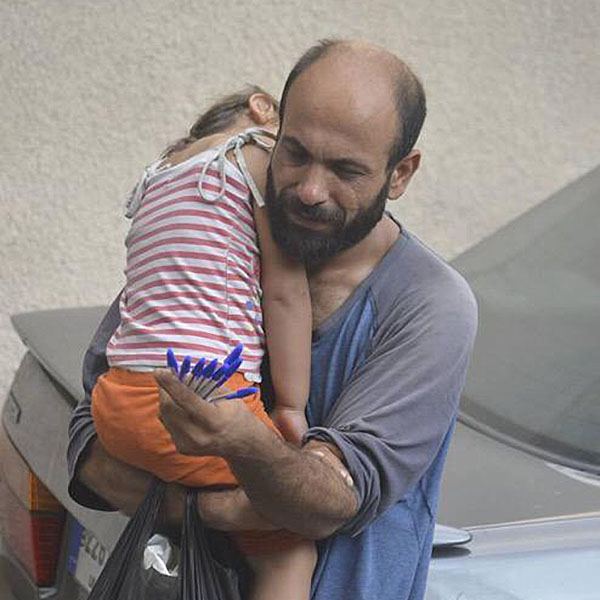
Image: Gissur Simonarson. This photo of a Syrian father selling pens in the streets of Beirut raised more than US$150,000 for the Syrian refugee.
Dear Readers,
Last month a viral Tweet changed the lives of a Syrian refugee and his daughter (pictured above) when thousands of dollars were donated to help the two. We read that thousands of Icelanders have offered to take refugees into their homes. Syrians at train station in Hungary did not fare so well.
Such glimpses into the life of refugees are powerful. I am also looking forward to the film Salam Neighbor coming out this fall; it follows the journey of Zach and Chris, the first two filmmakers allowed to register and receive a tent inside a refugee camp. You might also be interested in the story of a recent Bethlehem Bible College graduate who took a step of faith and led his entire youth group, Palestinians, on an eye-opening short-term trip to minister to Iraqi refugees in Jordan.
Here in the US, we are entering election season, and immigration is a hot and divisive topic. That may be why we don’t hear much about immigration from the pulpit, says Matt Soeren, who points us to studies and sermon resources that could turn that around (Leadership Journal).
Politics aside, mission leaders like J.D. Payne point out that international migration is at the nexus of many of the world’s most challenging problems. You might want to listen in on J.D.’s conversation about migration and missions with leading diaspora missiologist Enoch Wan.
Don’t know where or how to begin to help refugees? Check out Exodus World Service. Working with Exodus, members of The Village Presbyterian Church in Northbrook, Illinois recently delivered their 100th Welcome to America! Pack. The church’s dedication to welcoming arriving refugee families over the last decade is a wonderful demonstration of God’s faithful care and concern for the stranger in our midst.
Love sports? Read Sports, Soccer, and Boxing as they Relate to Diaspora Missions and Evangelism (Billy Graham Center for Evangelism). Amy Walters of SEND International provides some helpful tips on reaching out to refugees. However you reach out, keep in mind these best practices of immigrant ministry from the Wesleyan ministry Global Partners.
Finally, several years ago, faithful Missions Catalyst reader Neal Pirolo published a motivating book on reaching internationals who live among us, and it’s full of great ideas related to ministry among refugees, immigrants, international students, and more.
Blessings,
Pat
Source: INcontext Ministries, August 2015
During this year of spiraling crises, with millions of people already forced to flee from their homes and many thousands dying while trying to get to safety, the global humanitarian system has been severely stretched. Global forced displacement is currently reaching unprecedented levels:
In this age of unprecedented displacement and suffering, the church needs an unparalleled response and a renewed global commitment to imitate Christ, the father of all compassion (2 Corinthians 1:3).
In John 11:35, we find the heart of Christ for those in need: “Jesus wept.” Tears of compassion well become Christians and make them most resemble Christ. It is indeed a season for anguish.
» Read full story and watch David Wilkerson’s message A Call to Anguish.
Source: SAT-7 News and Prayer, August 2015
Now in its third year of broadcast, My Church in Algeria [a program in the Kabyle Berber language] is reaching thousands of remote communities across North Africa.
A secluded Protestant church in the Algerian mountains has quickly grown to over 1600 members. Daughter churches are now meeting in different cities to accommodate numbers.
Program producer Samia Jallali Kessai is heartened by the commitment of many members: “In the winter, it is very difficult to find a way up to the mountains. People have to wake up at 5:00am to get transport. The church service starts at 9:30am, but by 8:00am you will find that the church is full and many cannot find a seat.”
Every Sunday, SAT-7 broadcasts from the church. My Church in Algeria is one of the few programs broadcast in Berber on SAT-7 Arabic. A viewer from Morocco says, “Before we start our cell group church in my house on Sundays, we watch My Church in Algeria because it is in Berber.” Samia helps subtitle the recordings into Arabic: “We want to make it available to as many people as possible. It is particularly exciting as there are many communities in Morocco, Tunisia, Libya, and Somalia where Berber is better understood than Arabic.”
» Read full story. See also a longer version on the SAT-7 UK website. SAT-7 also broadcasts a documentary series featuring the stories of Algerian men and women who have come to faith in Christ.
Source: INContext Ministries, August 5, 2015
On July 14, 2015, Iran and six world powers (America, Russia, China, Britain, France, and Germany) agreed on a historic deal to limit Iran’s ability to develop nuclear weapons.
But the conflict in the Middle East is far deeper and wider than just the nuclear threat. Four Arab civil wars are currently being fought—in Iraq, Syria, Libya, and Yemen—with Iran, America, and Saudi Arabia supporting a complex mix of warring parties.
These charts show the complexity of the conflicts that stretch over religion, ideology, ethnicity, and class. What is evident is that the Sunni-Shia rift has become more acute, with Shia Iran and Sunni Saudi Arabia playing leading roles on either side of the divide.
» Read full story. The original chart and analysis behind this piece were published in The Economist in April.
» Editor’s note: Let’s keep praying for all these powers in the Middle East, and note that September 23 is a global day of prayer for Saudi Arabia.
Source: IMB Connecting, August 1, 2015
“Farishta,” a young, unmarried woman from a large Central Asian family, wanted to show “Marcie” [an IMB missionary] how to perform namaz, the Islamic ritual prayer done five times a day.
Marcie shifted on the tea-stained couch and slowly shook her head as she told Farishta it wasn’t necessary.
Pointing to her cup of milk tea, Marcie asked, “When I leave and you wash this cup, will you wash the outside and the inside?”
“I’ll wash both the outside and the inside,” Farishta said.
“If you don’t wash the inside of the cup, will it still be dirty?”
“When we pray, it is important to have clean hearts before God. When I pray, I am sharing my heart with God and then listening to how he wants me to pray. Sometimes how God wants me to pray is different than I thought.”
Farishta looked at Marcie inquisitively, but changed the topic. A few minutes later, however, she brought up the topic again.
“Let me just show you how to do namaz,” Farishta insisted with a warm smile. Farishta did not understand why Marcie didn’t want to do Islamic ritual prayers. Everyone in Farishta’s community performs namaz.
“You know, namaz prayer has a special reward from God if you do it. I can show you how to do it right now,” Farishta said.
» Read the rest of the conversation. Also see sidebar stories about praying for Muslim women and hosting a women’s prayer tea.
In This Issue: Great Words about the Great CommissionSource: GMI Missiographics
While most of us can recite the famous words of the Great Commission, it’s another thing to walk faithfully in them. Take a moment to look at the Great Commission in light of these powerful words and be encouraged in your outreach.
Great Quotes on the Great Commission includes 17 quotations are all included in the book Expect Great Things: Mission Quotes that Inform and Inspire, compiled by Marvin J. Newell.
» Access full-size graphic in several formats and read some thoughts about how to use it, then browse the Missiographics library or subscribe to receive Missiographics by email.