
In this issue: Six reasons to cancel that overseas mission trip
In this issue: Six reasons to cancel that overseas mission trip
 By Shane Bennett
If you’ve read more than two of my columns, you know I have totally drunk the short-term missions Kool-Aid. You’d be hard-pressed to find a bigger advocate. In fact, I’m dying to invite you to come on a short-term to Sicily with me! But just for fun, this month we’re going to look at why you might not want to go overseas—why instead, you may want to do something just as cool but that’s within a stone’s throw (or a day’s drive) of your house.
So here are six reasons why you and your church should not plan an amazing trip to Faroffistan this summer, but rather do something equally strategic and helpful nearby. [Click to tweet this]
I for one have stood on the rooftop of my short-term housing in Faroffistan and wistfully watched planes fly away, whispering in the darkness of my own heart, “Someday soon I will be on one of you!” Being more spiritual than me, you probably have felt another kind of sadness nearing the end of a short-term assignment: something like regret that you couldn’t stay longer, a sense of tearing as new found relationships come to an end, a wish that you could complete or at least continue the work your team began.
Well, good news: If you do a short-term trip near where you live, you live near there! (Take whatever time you need to process that logic, then read on!) You can go back next month or next weekend. You can have your new friends over for a barbecue. No plane ticket. No passport or shots. Just gas money equivalent to the change you can scrounge from under the couch cushions.
For many of us, the key value of dropping into a foreign culture can be pretty much accomplished within driving range, sometimes walking range, of our house. If you arrange your efforts to focus on people different from you and to engage them in conversation, you’ll get at least a little bit of cultural disorientation (and connection).
Furthermore, if you focus well, and perhaps drive a little farther, you can serve unreached people. There may be communities near you representing whole peoples who’ve largely been overlooked in our sharing of the kingdom of God.
If you’re into missions, you may have heard this, “I don’t know about going all the way to Faroffistan. We have plenty of needs right here and the Bible says to bloom where you’re planted.” Well, we do and it doesn’t, but there is a point here. Steve Hawthorne said that being exclusively concerned about overseas stuff is like a team who only plays “away” games. It’s silly. God has placed us where we are and we do have a certain stewardship for our place. It would do us well to look around a bit and ask God what he’s up to here.
And you’re telling me you’re going to take them overseas? Let them get groped by TSA along the way? Expose them to Zika? Probably lose them in a crowded train station in Calcutta? (Yes, I am reading your mom’s email!) I’m all for taking kids overseas, but I figure the effort required to shift the family is large enough to make a one-year stay the minimum for most families. And cross-cultural exposure is so important that if you don’t already live someplace like San Francisco or Amsterdam, you may need to make some special efforts to get your munchkins immersed among people different from them. If you don’t want to give Mum a coronary, doing that domestically may be a good start.
OK, work this out to its logical extreme and the cheapest thing to do is stay on the couch! I get that. But making a cross-cultural experience more accessible to more people is a worthwhile idea. For good reasons or bad, some of our friends cannot imagine finding $2500 to spend a week in Faroffistan. But they might pony up US$250 for a long weekend of immersion in a nearby city. And sometimes it only takes three or four days of hugs and hummus to change minds and knit hearts to newcomers. [Click to tweet this]
While I was writing this column, President Trump was signing a new executive order limiting refugee admittance and temporarily banning travel to the US from several countries. We may think the order is ill-advised and will do little to increase the security of Americans, but this much also seems true: We shouldn’t complain if we’re not willing to act. I feel a little foolish ranting and raving about my country not letting in refugees while I myself fail to drive across town for tea with some who beat the ban. This spring break or summer could be a really good time to go hang out with refugees.
What have you done to connect with unreached peoples domestically? If you were going to take a small group from your church to reach out to refugees nearby you, what would you do? I’d love to hear your ideas and experiences.
» Please take a moment to share them with us below or through Facebook.
If this kind of experience seems like a good idea for your church, but you don’t know where to start, let’s chat. A good bud and I are once again dreaming and scheming about effective, high-caliber, domestic, unreached-focused, short-term trips. And, well … we need some guinea pigs!
» Email Shane.
You’re smart, right? I’d like to hear what you think about a couple of things: What are Paul and Patty Pewsitter thinking about Muslims? What are their honest concerns? What’s behind their anger, if that’s present? How do you see them connecting or are they largely apathetic? And secondly, what will help shift them to more intentional engagement?
If you guessed that I’m asking as an effort to do some crowd-sourcing for Muslim Connect, you’re right. In case you missed our previous promotion of this new effort, it’s a 300-word drip feed to help us think about Muslims the way God does and to love them like Jesus. I’d love for you to subscribe and share it in your circle of influence. Together we can shift the foundation of thought and action toward Muslims.
» Comment below or on our Facebook page or send Shane an email.
Source: Religion News Service, December 14, 2022
As Christmas approaches, children in many parts of the world look forward to a visit from the potbellied Santa Claus, who comes down chimneys carrying a sackful of gifts over his shoulder. In Japan, some children also wait for Hotei, a jolly Japanese god with a rotund frame who carries a similar bag full of treasures. Hotei’s visit, however, coincides with the new year.
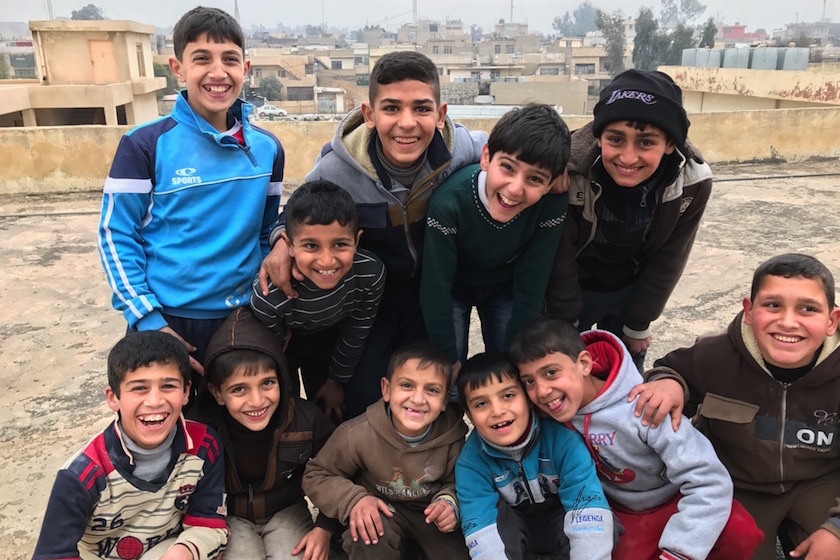 Children in a Mosul neighborhood; story below (Preemptive Love Coalition).
Greetings!
Several of today’s news briefs steer us away from the headlines with glimpses of smaller stories that tend to get lost in the shadows:
Where do you go to seek out stories from the shadows? Our news briefs are, by necessity, brief. Longer works may make a bigger impact. Have you seen any international films or documentaries that have made you think? What about books? Recently National Geographic (partnering with the audio-book company Audible) put together a list called Around the World in 12 Books, which could give you a year’s worth of armchair travel, or, maybe better, inspire you to make a list of your own.
Share your picks with us through Twitter, Facebook, or the Missions Catalyst website, especially if you’ve found good candidates to use with a small group, team, church, or family.
Blessings,
Pat
Editor’s note: Much thanks to all who let us know that the video about churches among the unreached which we featured in last week’s Missions Catalyst is no longer accessible. Sorry! The producers found a mistake they couldn’t fix and felt they had to take it down.
Source: Preemptive Love Coalition, February 19, 2017
A devout Muslim, Waleed worked for years as a soldier with Special Forces, and he has the sorrow and stories to prove it. He is more than qualified to work as a security specialist on our front-line deliveries. But now, standing there with that big grin on his scarred face, he looked more like a little kid.
How can he be smiling? We’re in a bombed-out church in the heart of Mosul, where ISIS had painted a giant black flag on the cross out front. Where thousands of Christian homes were marked with the Arabic letter “N,” their lives threatened with the sword, their possessions looted [and] families ultimately driven out of their ancestral neighborhoods like cattle.
Already that day, we’d picked through airstrike wreckage, seen rotted bodies of ISIS fighters, heard and felt and seen the battles of this god-forsaken war, heard stories of untold suffering—and now, standing in this bombed out, burned-up church, Waleed had the nerve to grin at the destruction?
“See? Look up… they missed it.”
» Read full story and/or watch the two-minute video.
» See also Mass Christian Immigration from Iraq Makes Future of Church Uncertain (Voice of America), and read about Burmese Christians ministering in Mosul (Christianity Today).
Source: International Mission Board, February 22, 2017
Every year when the list of Oscar nominees is released, I scour it to find obscure titles tucked away in each category. One group that is always full of gems is “Best Foreign Language Film.” The five movies included are selected from the best of the best that the international film community has to offer. Foreign films offer me something most of the Hollywood-produced ones don’t—a glimpse into a different culture’s worldview. Although I live and serve in Africa, a submission from Australia caught my attention this year.
Tanna, directed by Bentley Dean and Martin Butler and filmed on the Pacific island nation of Vanuatu, is a classic Romeo and Juliet tale of forbidden love. However, since the story was conceived and acted by the indigenous people of Yakel, it’s full of insights into their values, fears, and attempts (and failures) to answer the questions of life.
The challenge the characters in Tanna confront—what cultural norms must be abandoned to preserve life—is similar to one Christians ministering cross-culturally often face: What elements of a culture must be abandoned in order to follow Christ?
Watching films created in different cultural contexts helps me evaluate my own cultural biases and appreciate the diversity of life in our world.
» Read full story and another recent IMB article about biblically faithful contextualization.
» Readers might also be interested the film The Enemy God, recently made available for streaming and download. Want training in film making? Check out the news about the Academy of Frontier Media and Arts (with thanks to Brigada for the tip!)
Source: World Watch Monitor, February 20, 2017
Ten white plastic chairs are arranged in a circle on the roof terrace of a four-story apartment block housing hundreds of Asian laborers. This is a part of Qatar where tourists never come—Doha’s Industrial Zone, where all the hard groundwork is done to maintain Qatar’s image as a modern state. The roads here in some areas are bad, there are no streetlights, and the air is filled with fumes.
Although it is officially illegal to meet outside of government-approved areas, tonight a group of Christians will meet here together to read the Bible and pray.
Most visitors will see only grand, extravagant palaces, brightly illuminated skyscrapers, and futuristically designed mosques in Doha, the capital. Within a few years, a dozen new architectural accomplishments are going to join those landmark buildings—state-of-the-art football stadiums for the 2022 FIFA World Cup, which are said to be costing the country $500m a week.
But the FIFA PR show cannot hide the other side of Qatar—a profoundly intolerant country for non-Muslims. There is a deep division between the extremely rich Qatari nationals, who are now a tiny minority in their own country, and the hundreds of thousands of often exploited laborers, mostly from Asian countries. Reports from charities such as Open Doors suggest there are serious dangers for those not part of Qatar’s Muslim elite. Qatar is ranked 20th on Open Doors’ 2017 World Watch List of countries in which it is most difficult to be a Christian.
» Read full story. A related article describes Christianity in the Arabian Peninsula.
» Also check out Qatar Needs to Stop “Playing the Victim Card,” in which a Qatari author touches on domestic worker abuse (Doha News).
Source: Mission Network News, February 17, 2017
Last summer while in Pakistan, Bruce Allen [of FMI] had met a couple who had just gotten baptized.
These two new Christians were on fire for the Lord and wanted to grow in wisdom and encouragement and to share their faith with their family as well as others. In fact, this was their main prayer request.
“Habib did indeed have an opportunity to share his faith with his family—and they promptly tried to kill him, throwing him off the top of the building,” Allen shares.
Imagine that, having the very people who are closest to you, know you most intimately, violently turning on you for sharing the gospel. It’d be easy to understand if Habib had grown bitter and vowed to never return. But that’s not his story.
Just last month, Allen was back in the country, meeting with new believers and even was able to see some new believers get baptized.
“At the end of that day, having conversations with some of the people who were baptized, we discovered that it was Habib’s family who had gotten baptized.”
Habib and his wife’s steadfast testimony was impactful and influential, and God used it along with his Word to bring this family to him.
» Read full story and also another FMI report about ministry in Pakistan, It Begins with One Cup of Tea.
Source: Operation Mobilization, February 16, 2017
What if the Bible wasn’t in your language? What if you thought God didn’t speak your tongue? What if the Bible was in your dialect, but you had to rely on other people to share it with you because you couldn’t read it for yourself?
Such is the reality of many unreached people groups across the globe, including the Islamic Yao tribe in Malawi.
Up until 2015, the Bible was unavailable in the tribal language of chiYao, in written or audio format. Today, the whole Bible is ready to be heard through AudiBibles.
In the first seven months of 2016, the OM Malawi team handed out 297 solar-powered AudiBibles. Each recipient of a device is expected to start a weekly listening group, as the Word of God is meant to be shared.
“The AudiBible is a true preacher,” said Fredson Phiri, one of the AudiBible trainers. “It doesn’t add, it doesn’t subtract; it gives the whole truth to the person. It preaches itself.”
» Read full story and other OM articles about ministry in Malawi.