
Joining with Jesus in the Way He’s Made You to Bring Heaven Here

By Shane Bennett

So many fish! image of a catch of fish

I’m an amazing kayaker. In my mind, that is. In the physical realm, not so much! I once picked up a beautiful, hand-made wooden kayak at a garage sale. The first time I tried it out, I managed to balance and very gently paddle it… on a pond. For my second effort, I took it to a way-back cove in our local reservoir. I had managed to gain a semblance of control amid the slight lake ripples when a nearby DWAB (dad with a boat), decided to pack up the family beach picnic and roar out of the cove full throttle.
 
As I hopelessly watched the tsunami roll my way, I remembered with distress a snake I’d seen swim by—and realized I hadn’t seen it get to the edge. After dumping into the water, I slowly headed to the shore, one arm swimming, the other holding onto the upturned boat. Only then did I muse, “Maybe kayaking is not for me.” 

What about you? What do you wish you were better at? On the other hand, what is one thing you do better than the average person? These are fun and universal questions to kick around. I ask them today because I want to share how Jesus met Peter in the midst of what he could do and what he was going to get really good at doing. 

Who’s The Better Fisherman?

Luke records for us in chapter five that Jesus was teaching the crowd God’s Word. Oh, how I wish that phrase was in blue, underlined, and linked to a full transcript of the talk! 

Whatever he was saying must have been pretty good, because the crowd kept closing in until Jesus asked Peter if he could hop up on his boat. Peter agreed, but it turned out Jesus was starting an epic version of “if you give a mouse a cookie!” 

Jesus finished his teaching and asked Peter to row out a bit and let down the nets. Torn between knowing how (and when) to fish and thinking Jesus was pretty cool and maybe not wanting to wash the nets again, Peter obliges. 

The resulting catch began to break the nets, even threatened to sink the boats. Ponder this for a minute: Did Jesus cause the fish to gather in Peter’s nets? Or did he create fish that hadn’t been there just moments before? And if so, when they landed on dining tables the next evening, were they not the best-tasting fish anyone in Capernaum had ever had?

Peter, for his part, read the room, dropped to Jesus’s knees, and begged him to depart, explaining, “I am a sinful man.” Peter realized this wasn’t a matter of trying a little harder, maybe losing a few pounds and he’d measure up. No, Jesus had just double-trumped him at the very thing he was good at! Jesus was on a whole other level. Best to face the music honestly. 

Seeing Jesus in action should naturally make us wonder how far we fall. It’s scary to feel afresh how amazing Jesus is and then realize what a train wreck we may be. I believe we need this occasionally, but the weight can be devastating. May we move quickly from “amazing Jesus” to “I’m a train wreck” to the realization that Jesus lifts our face, our eyes, to his and says, “You are forgiven. I choose you.” 
 
And he does choose us, like he chose Peter, “Don’t be afraid. You’re going to be a fisher of men.” 

(Parenthetically, good thing Peter’s job was fishing and not selling cars or working as a short-order cook!)

Five Styles of Contagious Faith

As a reader of Missions Catalyst, I would guess you’re a fan of the idea that disciples of Jesus are still called by him to gather people into the kingdom of God. Although I’ve not been the best example, I couldn’t agree with you more. I love it when Paul says we’re ambassadors of Christ. I believe when Jesus tells us to pray “Father… let your kingdom come and your will be done on earth as it is in Heaven,” we’re agreeing to do our part in that. 

But sharing our faith can be hard, confusing, frustrating, and fraught with guilt and shame. Here’s something that has encouraged and energized me lately:

Mark Mittelberg, author, academic, and partner-in-crime with Lee Stroebel, writes about five styles of contagious faith. He says when we think about sharing our faith, we feel most natural in one of these five approaches

  • Truth Telling: Someone with this style is more direct and hard-hitting. They might like knocking on doors of strangers or walking up to people and doing surveys in the shopping mall or meeting new people that just moved in. This type of person is bold about getting to the point, talking about spiritual matters, and so forth.
  • Reason Giving: Someone with this style tends to share evidence and answer questions. They may help with more of the cognitive side, the intellectual side, of Christianity and help people realize Christianity is true and it makes sense. Some people can open the doors and build friendships; others answer questions.
  • Story Sharing: This person likes to tell their testimony and share their story. They talk about their experience with Christ in a way that can influence and affect the experience of the other person.
  • Selfless Serving: This person helps others and makes a difference in people’s lives in tangible ways. That helps open doors to also share about the love and truth of Christ.
  • Friendship Building: This approach is seen in someone who’s more relational and connects with people in natural ways, but through those relationships then begins to share their faith. 

Which of these styles most resonates with you? Definitely friendship-building and story-sharing for me. Hearing that Jesus wants me to share him in ways that emanate from who I am is freeing for me and makes me want to give it a fresh go. I don’t anticipate bringing in nets full of people like Peter did (3,000 in one day!), but I want to do my part. There’s a lot of pain and fear swirling around these days. Jesus would like to replace that with abundant life.

A Quick Heads Up: Taking a Break

After almost 20 years of writing Practical Mobilization columns, I’m going to take a six-month hiatus. Our intrepid publisher, Marti Wade, will make sure you get a monthly dose of great content. She’s the best.

To help us to stay in touch, please click this link to get my super short weekly email about loving Muslims. I’d be honored if you do so and I think you might find it practically helpful and maybe a little funny. 

Anniversary Special: 30 Years of Encountering the World of Islam

If you’ve been waiting for the right time to take the 12-lesson Encountering the World of Islam course, this is it. To celebrate their 30th anniversary, our friends at EWI are offering their online course for just $99 (regularly $249). This only applies to the summer online class, but that’s just around the corner: May 2 to July 31. Join us in celebrating EWI and inviting others to participate!

Learn more and sign up.

To Dodge or Not to Dodge

Hearing & Heeding Hard-hitting Words from John the Baptist & Ralph D. Winter

By Shane Bennett

Turns out my seven-year-old son has a superpower. Not the “power of hyperspeed” he imagines but the power of dodging. Yes, dodging. I’ve seen it in action.

Months ago, while we were enjoying some family time on the front porch, his 12-year-old sister inadvertently dribbled the basketball off her foot. It caromed directly toward the boy’s face, who, though not watching, tipped his head out of the way with scary-good timing. The ball sailed by instead of giving him a bloody nose.

Then, two weeks ago at dinner, I failed to account for Colorado’s extreme barometric pressure swings when I opened the ranch dressing. This resulted in a thumb-sized glob of dressing rocketing across the table. Again, with uncanny timing, the boy leaned to the side, allowing the dressing to hit and subsequently drip down the chair right behind where his little, lithe body had been. I know not what this superpower portends!

Similarly, I seem to also have a gift for dodging, though it’s less a superpower and more a refined avoidance. Prepping to preach on John the Baptist this past week brought this home for me. Some listeners wanted to dodge John’s message: the Pharisees and Sadducees desired the virtue-signaling points of getting dunked but not the hassle of changed behavior.

As for Herod, he dodged by tossing John the Peskiest into prison.

The Radical Message of John the Baptist

It seems that the crowd, some tax-gatherers, and the soldiers honestly wanted to feel the full weight of John’s message. I was stunned by their questions and John’s answers. And I don’t want to dodge them.

If you’ve read through the Gospel of Luke a few times in your Christian walk you may find it easy to breeze by what John tells them. I think, at least for me, it might be worth a non-dodging pause:

Crowd: What should we do then?
John: Anyone who has two shirts should share with the one who has none, and anyone who has food should do the same.

Tax collectors: Teacher, what should we do?
John: Don’t collect any more than you are required to.

Soldiers: And what should we do?
John: Don’t extort money and don’t accuse people falsely—be content with your pay.

In each case, John is saying, “Do right regarding your resources and do right to others who lack your resources.” One commentator says, “Luke possesses a sensitive, compassionate theology of the poor.”

I wonder: Do I?

Choosing a Wartime Lifestyle

As that question rolled around in my head, I remembered a scary, provocative article that might have made John the Baptist proud, A Reconsecration to a Wartime, Not a Peacetime, Lifestyle by Dr. Ralph Winter. If you’ve taken the Perspectives course you’ve probably seen it. Maybe like me, you dodged it or tried to dismiss it.

Basically, Dr. Winter said to live on the minimum amount of money and stuff you need so that you can direct the excess toward the best kingdom use.

What I inadvertently heard was, “The poorest among you is the holiest.” While that may sometimes be the case, it’s not what Winter was advocating. He clarified this in 1983 in a family profile in Missions Frontiers:

“A wartime lifestyle may be more expensive or less expensive than simple,” Winter explained. “If a man is out in a trench and he’s eating K-rations, he’s not using up much money, but a guy who’s flying a fighter plane may be using up $40,000 a month of technology. In other words, during wartime one doesn’t judge according to the same model of lifestyle. What’s important is getting the job done.”

Two Key Questions

With John the Baptist on one hand and Ralph Winter on the other, I have a couple of questions. I’m asking them of myself and invite you to consider them as well.

1. Do our baptized, repentant lives reflect a “sensitive, compassionate theology of the poor”?

Do you find that in your life, your church? Generally in the Church throughout your country? In the U.S. these issues seem to have taken on partisan shadows in recent (or maybe not so recent) days. But what would it look like to view them less politically and more biblically?

I wonder if there are Christian responses to the poor and marginalized that transcend party affiliation? Surely many believers are doing many amazing things that would make Luke say, “Yes, that’s exactly what I was thinking when I wrote that!”

But for others of us, me included, we may need to keep thinking and take the risk of asking God to shape and direct our thinking. We need to pause before slipping into popular tropes and cliches about why things are the way they are and what is and isn’t being done.

To gain some perspective on your personal food situation, just in case John asks you to give some away, ask yourself this question: If you only ate the food currently in your house, without going out to eat or buy more food (except for milk!) how long could you go? The couple from whom I poached this idea went for 147 meals!

2. What does it mean to live a wartime lifestyle and who should try to do so?

Second part first: If Winter had his way, every one of us would adopt this practice as soon as we toweled off after baptism!

He suggests in his article (written decades ago) that everyone in his denomination could live on what an average pastor or support-raising missionary makes. Pastors may be doing a little better these days, I don’t know. But what about that? What would that mean for your lifestyle? I wonder what would happen if I floated the idea out to the little church where I serve as associate pastor? Could be I wouldn’t have to preach anymore for a long while!

One of the reasons this is on my mind is that I’ve been scheming with a small band of brothers and sisters about how the remaining 1,600 or so unengaged people groups might get gospel workers on the ground among them. I’ve wondered aloud about the possibility (and wisdom) of hiring people to do it! We hire pastors, don’t we?

How many wartime lifestylers would it take to free up funds to hire 1,600 small teams of missionaries? How cool might that be?!

Subversive Mobilization: Conversations with Greg Livingstone at 82

During some gut-wrenching life circumstances a few years ago, I connected with my long-term hero, Greg Livingstone, in a new and personal way. We’ve stayed in touch and recently embarked on a project that’s been super fun for me. We’re recording a series of short videos in which I ask Greg things I’d like to know about his life, work, leadership, and thinking. 

This is pushed forward by the fun of it as well as a two-fold purpose:

  1. To preserve some cool things Greg thinks and has done in his life.
  2. To give him a chance, at 82 years old, to unleash his recruiting chops on a new generation of people.

I would flat out love for you to give these a look. Greg and I are not amazing YouTubers (even with my friend Jeremy’s great editing help)! Any advice you’d like to offer in terms of content, production, and distribution would be met with gratitude.

Watch the videos.

Blessed to Be…

Using Our Gifts & Privilege for God’s Glory

By Shane Bennett

Read or share the email edition or scroll down.

Have you had a chance recently to consider how good you’ve got it? I’m talking about a deep down, soul-lifting consideration of God’s gifts to you. The sort of thought process that reminds you you didn’t hit a triple, you were actually born on third base!

If you’re going through hard, hard times right now, it might be tough to think this way. But it also might be particularly important. I haven’t spent much time on the precipice of despair, but maybe an effort to focus on what isn’t terrible could be a good way to walk back from the edge.

A serious inventory of the good stuff in our lives might also pleasantly remind us that we serve a God of abundance and abundant goodness.

The God of Abraham

Imagine the beep, beep, beep of God’s “Dump Truck of Amazing Gifts” as he backs it up to Abram’s tent and begins to raise the bed! “Abram! Grab your wife and get out here. I’m fixin’ to bury you in blessing! (What? God’s not Texan?) You’re going to have a land that’s yours. You’re going to have more kids than you can count! I’m going to elevate your regard among all men. I’ll have your back and mess with the people who mess with you. And, get this, both of you, you have a purpose beyond your imagination. You are charter members of the Global Blessing team. We’re going to take these gifts to every clan on the planet.”

The presents you and I get may be different from what God gave Abraham and Sarah, but they are similarly huge, certain, and rich in purpose. When I lived in Holland, I remember walking down the charming streets of Amsterdam, shaking my head and thinking, “How did I get so lucky to live and work here?” Even now, in southern Colorado, it’s crazy good. As I write, intrepid workers are installing solar panels on our roof to capture power from the wonderful number of sunny days here.

It may be cloudy where you are, but I hope you share my sense that a good God has smiled on you lovingly and abundantly. If so, there are two things I’d like to say.

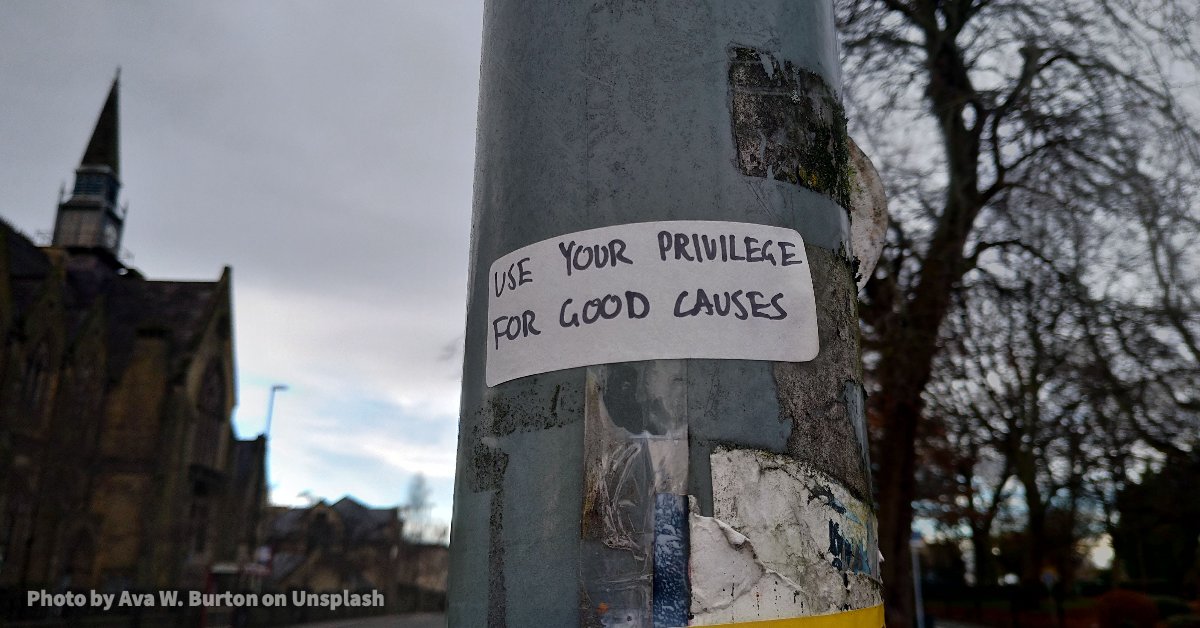
1. Let’s recognize our privilege.

I know “privilege” is a provocative word these days and I don’t choose it lightly. But I can’t get around the sense that I have some advantages. I can make a long list of things in my life I did little or nothing to bring about but that make everything easier than it might have been. Maybe you do, too?

I grew up with two parents who stuck it out through thick and thin and three siblings who didn’t kill me though few would have blamed them if they did. Through junior high and high school, I had a pastor who pumped value into my friends and me and valued Jesus even more than he valued us.

I don’t worry about food, either the amount or the safety of what’s available. Nor water. Nor whether or not I can keep the house warm enough this winter to keep the kids healthy. Nor if there are resources for medicine if they do get sick. 

And I know I’m part of a society that is still generally run by privileged people like me (see here, here, and here) and they still generally run it for their (and my) benefit.

To be honest, I’m not sure how to deal with that. If you felt like God was leading you to devote your life to leveling the playing field, I’d cheer you on. But if the lone African American woman in my Perspectives class two nights ago, or the Mexican woman sitting near her, looked at me and asked, “It’s not fair the way the system is organized right now. What will you, as an insider, do about it?” I’m not sure how I’d respond. I hope I would at least listen to them and at a deep, honest level believe what they said.

This irony is not lost on me: I have the privilege to sit in my comfy chair, in my comfy house, and ruminate thusly, fully expecting you’ll read what I type on my new MacBook Pro.

2. Let’s consider what to do with it.

Sometimes Jesus asks us to give up everything, right? That was his prescription for the rich young ruler in Mark 10. Zacchaeus only had to give up half (and four times whatever he had gained by cheating!) Sometimes we expect that to be the vibe: God or a mythical preacher extending his mythical bony finger toward us and saying, “Thou shouldst giveth away thy goods and pecuniary resources!” Fair enough. The Bible shows us there’s a time and place for that.

I prefer the biblical model of stewardship. Every good gift comes down from the Father and is intended to bless his kids and facilitate their involvement in his kingdom-building enterprise. As good stewards we:

  1. Assess what we have, e.g., money, stuff, gifts, abilities, privilege, or even spiritual maturity forged in suffering.
  2. Compare that to the overall goal. Short version: Genesis 12:3b. For the longer version, take Perspectives!
  3. Figure out how the first step gets you to the second.
  4. Critique your stewardship success, but maybe not that of Bob in the pew next to you!

I so want to be faithful and true in this, but often fall short.

Last week, I read a super fun book related to this. (There’s the privilege again: I have the time, eyesight, resources, and security with which to read super fun books.) In More or Less, author and cool guy Jeff Shinabarger asks us and himself, how much is enough, and what would it look like to live a life of extravagant generosity?

Jeff made me wonder what I have an excess of and what it might be like to give that away. Some of the things he did seem easy: Decide how many t-shirts you need and give away the rest. Others, not so much. He and his wife gave up a huge chunk of their backyard to be a community garden. Personally, I need to grow in understanding where I have excess. I’m learning, slowly, how to give away money.

But one thing I have more of than some people is access to the attention of sharp believers. Yep, I mean you, among others. Believing that access to be a gift of God, I want to steward it to the best ends. When appropriate, I want to open doors for people who weren’t born into the privilege I was, but—and this should come as no surprise—have important things to say about God’s global purposes. (If that’s you, I’d love to chat!)

Grace to you as you steward your time, health, privilege, and money. May God lead you in a few minutes of reveling in the good gifts of your savior and the delight of being chosen by him. It might help you to crank Matt Maher’s Alive and Breathing! It sure does me.

Subversive Mobilization: Help Needed

Psst, over here, I’ve got a quick question for you: If God has given you skills in the dark arts of admin and IT, I could use some help. I need someone to help me drop fewer balls and help me with the content delivery I think God may want me to be about. If that sounds interesting (or more importantly, like good stewardship) for you, shoot me a text (719.251.1403). Let’s do some cool stuff together.

Counting What Counts: Notable Numbers for the New Year

By Shane Bennett

Want to know something funny and a little embarrassing? I will probably check Mailchimp a gazillion times the day this article drops to see how many opens it has had and how many links were clicked. I’m neither proud of this, nor apparently sufficiently disciplined to stop doing it. Turns out my checking makes no difference in the numbers.

Other numbers are a little more important to count. I’d better mind the minutes until the kids’ bus arrives or I risk leaving them stranded on the road. And I count the minutes until my wife gets home because her return makes me happy. 

There’s a whole realm of health numbers getting counted in these early days of the New Year: How many calories did you consume? (Too many.) How many ounces of water did you drink? (Too few.) How many steps did you take? (You’re averaging fewer steps this week than last!) Ack!

In Psalm 90, Moses asks God to “teach us to number our days, that we may present to you a heart of wisdom.” I like that a lot, especially this time of year. I want to be thoughtful about the days of life remaining to me. I want to number them well so that the relationships and results of my life comprise a wise and acceptable offering to God.

Here are some of the numbers I’m puzzling, grieving, and rejoicing over as 2022 gets rolling.

1. Only 50% of people have returned to church. 

It depends on whose stats you get behind, but it looks like up to half the people who were attending church before COVID started haven’t come back. Granted, Omicron is wreaking havoc and some are wisely staying home to guard their weakened immune system or the people they live with. 

But is there more at play? When I look up at the camera that streams my church’s services and greet the people who are attending via Facebook, I sometimes wonder, “Have you just found it more comfortable to stay at home?” 

I also wonder how many people found, in COVID, the opportunity they’d been waiting for to hit the road. It’s like when the person you were dating went away for the summer and you found that absence didn’t make your heart grow fonder, but rather made your determination stronger; you finally admitted it was over. 

What does this decline mean for missions? Have offerings dropped a similar 30-50%? Will support need to be cut for overseas workers? For domestic missions? And what is God up to in the midst of this?

Maybe God is using COVID to prune the Church. Maybe some of those who’ve opted not to drop their bums back in Sunday morning seats will lead the way to new forms of church. I cherish the way God redeems things that seem lost to me. I just sure hope he does so soon because this next number is also weighing heavily on me.

2. More than 400 Muslim people groups are unreached and unengaged.

Research of growing validity shows that 422 Muslim people groups have no one on the ground in their midst who speaks their language and is working their tail off to catalyze a movement of reproducing disciples. In this way, they are unengaged. Further research says that non-Muslim unengaged groups (Hindu, Buddhist, others) number 1,180. 

Unengaged peoples are certainly not the only thing God has on his heart. But I hope he’s planting Pauline ambition in many intrepid souls to, preach the Good News where the name of Christ has never been heard, rather than where a church has already been started by someone else. And may that passion, conviction, and focus burn so brightly and deeply that like Paul, they are “hindered” from doing anything less. 

The Bozo people of Mali are on that list of 422 and they’re recently on my heart. They live as nomadic fishermen. I wonder what it will take to take them off the list. Who can embody Christ in their midst? Who can find a way to live like they live and speak as they speak? Who can demonstrate and teach the good news in such a way that it is irresistibly good to the Bozo? 

I don’t know. 

But I believe that list of 1,602 unengaged groups will drop to zero. There’s growing, though still slight, momentum. A website focused on the unengaged is nearing beta testing. God’s people are praying, seeking, studying, and collaborating. It’s going to happen. (Ping me if that makes your heart race a little!)

3. 60, 17, 9, and 8,000 people.

You’ve probably heard about the fire in a Bronx apartment building on Sunday. Sixty people were injured, and of the 17 who died, nine were children. What I didn’t know until last night was that most of the dead were Gambians, some of the 8,000 or so Gambians who live in the US. Most of them are Muslim. I know little about Africa, but I’ve had wonderful interactions with Gambians. Please join me in praying for those suffering as a result of this fire—Gambians and others as well. 

4. Muslim Connect is five!

This week I’ll send the 260th edition of a short weekly email I write to help us think about Muslims the way God does and love them as Jesus does. It’s called Muslim Connect and, aside from brushing my teeth, is the most consistent thing I’ve ever done. I thank God for the health to do this and for the people who read it. If you don’t get Muslim Connect, please give it a try. At 300 words, it will only debit your week a couple of minutes. In the process of doing so, it might provide a timely bit of encouragement, a practical tool, or even a wry chuckle. Check it out and sign up here. (If you do so soon, you’ll be on board in time for the Five-Year Celebration Giveaway!) 

 
5. Got 2022 book goals?

Are you going for one a week? One a month? One? Even though I know leaders are readers, I fall short in this area. I often find myself reading for thrill rather than skill. I’m not sure Jesus is super impressed that I made my way through the entire Joe Pickett canon in the past 18 months.

This year I hope to read more books that will edify rather than simply excite. My pastor, our elder board chairman, and I are currently making our way through Tod Bolsinger’s book on adaptive leadership, Canoeing the Mountains. I recommend both the book and the practice of reading books with good buds. It multiplies the impact. 

This morning I ordered Atomic Habits by James Clear. Eugene Peterson’s biography, A Burning in My Bones, is on the list, as well as Loving Your Muslim Neighbor: Stories of God Using an Unlikely Couple to Love Muslim People . . . and How He Might Use You to Do the Same.

I also hope to drop in a couple of novels written by non-Western people of color. Americanah by Chimamanda Adichie helped me deal with my prejudice against Nigerians. I could use a lot more of that. 

What are you planning to read? What would you recommend to me and other Prac Mob readers? Take a second and drop us your thoughts.

We’ve no idea what this year will bring, but we know the one who has our backs. May God bless you with health, perseverance, and absolutely astounding kingdom success and joy in this new year.

Blessings, Shane

Practical Mobilization: Our Christmas Edition

Read or share the email edition, or keep reading below.

I’ve got a new favorite sound. You have a favorite sound, don’t you? The pleasing burble of a mountain stream or a 1972 Camaro. Your spouse’s laugh when you tell a joke. The silence of late-night Christmas Eve, with only the fire crackling in the background. Here’s my new favorite: The whoop of a 12-year-old girl when she discovers the book she’s had on hold at the library for weeks has finally come in! Yeah, that’s a good one. 
 
Books will do that, won’t they? That’s why they are the sole suggestion for this year’s Practical Mobilization Christmas Wish list. Here are some books making waves in my life lately:

  • Last week the great guys at The Traveling Team sent me A Book Called YOU: Understanding the Enneagram from a Grace-Filled, Biblical Perspective. I have a novice infatuation with the Enneagram but even as a newbie, I’ve been helped. Claude Hickman, The Traveling Team’s intrepid leader, didn’t send the book in order to get a mention here, but I love these guys! Go to The Traveling Team website, enjoy the cool vibe, then invite them to speak at your or church or university.
  • I’m also grateful for the recent, innovative efforts of William Carey Publishing. They sell great books, books written by and for the kind of people who read Missions Catalyst. You could do worse than getting a missions-minded bud a gift certificate to spend with WCP. 
  • Finally, if you have a sense that maybe the path before you is nothing like the path behind you, please join me in reading Tod Bolsinger’s Canoeing the Mountains: Christian Leadership in Uncharted Territory. My pastor, our elder team chairman, and I have formed an impromptu book club to go through this. Personally, I’m wondering this: If around 400 Muslim people groups remain totally unengaged with the gospel, what’s it going to take to get things started among them? What if what we’ve done in the past has worked as well as it’s going to and something new is needed? Answering that question is putting a lot of pressure on a book! But I hope Bolsinger will provide some insights. 

New Way to Help Afghans

In last month’s Practical Mobilization email I advocated for US State Department’s Sponsor Circle program, which allows five Americans to band together and host an Afghan family. In response, Pat Hatch, a Practical Mobilization reader who directs the Refugee and Immigrant Ministry for the PCA’s Mission to North America and has forgotten more about welcoming newcomers than I’ll ever know, reached out with an additional idea. It’s called APA Community Partners and has the potential advantage of being more integrated with an established resettlement organization. Church World Service seems to be the farthest along with their efforts to implement APA Community Partners.

As you might guess, Pat has been scrambling to help believers respond to the arrival of so many Afghans. In the midst of that, she’s inviting Mission Catalyst readers to attend her intro Zoom meeting, Afghan Arrival Big Picture tonight (Wednesday) at 8 pm Eastern or tomorrow (Thursday) at noon Eastern. If you’ve been praying for answers or direction, this may be it. Email Pat for more info and webinar dates in January. 

Can You Help a Guy Out?

In the next week, I’m planning to write an article for the robust Denison Forum audience called “Happy Halalidays: Christians, Muslims and an Immaculate Misconception.” I’d like to include some warm and winsome stories of people who’ve had Muslims over for a holiday dinner and lived to tell about it.

Assuming you’re pretty busy, I almost hate to ask. But I know some of you have killer stories. If you can share them, I’d be so grateful.

Three Notes for Christmas: God, Gratitude, and Grace

Is there a way to navigate the holidays and survive with your sanctification intact? You probably know better than me, but I keep coming back to three things: God, gratitude, and grace. We even made them the focus of our middle school youth group meeting this week, mainly so I could remember.

Keep God central.

It’s his birthday and all, but with Jesus’s marketing budget looking a speck next to Target’s, he sometimes gets sidelined. Can I tell you what I’m telling me? “Keep going to church. Devote your way through an Advent book or Bible plan. Get quiet for a few minutes and wonder again at God become man.” 

Cultivate gratefulness.

It’s possible I have more to be thankful for than you do right now. The goodness of God is washing over me lately in particularly abundant ways. Regardless, we all have much to thank God for and it remains one of the best remedies for the rampant consumerism that can characterize this season. Will you join me in thanking God for coffee, COVID vaccines, and countless other ways you may have seen his goodness?

Swim in grace.

Finally, grace. It’s what’s brought us safe so far and what will lead us home. As we have richly received, may we extravagantly give in the next few weeks.

  • Grace to the mom whose toddler slept and babbled peacefully the last two hours only to choose the ten minutes in Walgreens to scream like she’s being chased by two-headed snakes. (Don’t click that link! You’ve been warned!)
  • Grace to the pastor who’s had one more demand placed on them than they were designed to carry.
  • Grace to the dad who wants so much for his wife and kids, but honestly can’t figure out how to make the math work.
  • Grace to the cashier who’s walking a road we probably don’t understand.
  • Grace to the kids who’ve seen 18 gazillion ads screaming at them to want this thing now up against one dear Sunday School teacher who calmly admonished them to be happy that Jesus was born far away a long time ago.
  • And while you’re at it, grace to yourself. God gives it by the bucketful. It’s OK for you to enjoy a cup.

Christmas will not be perfect. Your brain’s messing with you when it says it used to be! But the baby is perfect, and his message is perfectly suitable for these days. 

Merry Christmas to you.

Practical Mobilization: Sponsor Circles for Afghan Refugees

By Shane Bennett

Some things are more valuable due to their rarity. For instance, solar eclipses are cool at their present rate. If they happened daily, we’d be annoyed. You may value people who exemplify Proverbs 31 because you don’t see them very often. (I mean the first seven verses, of course. Most women I know check the boxes on the second part of the chapter!)

An opportunity of exquisite rarity has just been offered to us. Last week the US State Department launched a program called Sponsor Circles that allows five American citizens to band together to help an Afghan family get going in the US. Not just give them a winter coat and a phrasebook, but enough to take them the whole nine yards from being a precarious and mystified stranger to being a productive community member.

The website for Sponsor Circles exuberantly reads, “No matter where you are located in the United States, you can welcome a newcomer and provide them with the practical support they need to get settled by serving as a certified sponsor circle. As a sponsor circle, you and your neighbors will take on tasks like finding initial housing, stocking the pantry, connecting children to school, providing initial income support, and helping adults to find employment.”

This amazing opportunity is not unprecedented. Americans could privately sponsor refugees under a short-lived program President Reagan initiated in 1986 called the Private Sector Initiative. While it was active, 16,000 refugees entered the US via private sponsorship, including thousands of Pentecostal Christians fleeing persecution in the Soviet Union.

It should be noted that, as in many efforts like this, Canada has led the way. Over the past 50 years, private sponsors have welcomed more than 350,000 refugees to Canada. Way to go, eh?

By now you may be wondering some of the same things I am:

Is this safe? What if we mess up?

Like first-time parents, we wonder, “What if we drop the baby?” The good people behind Sponsor Circles promise to help with the application process and training. Once you’re approved, they’ll link you with an agency that will help with tricky questions and challenging bureaucracy.

Jesus’s words from Luke 14 also apply, “Suppose one of you wants to build a tower. Won’t you first sit down and estimate the cost to see if you have enough money to complete it? For if you lay the foundation and are not able to finish it, everyone who sees it will ridicule you, saying, ‘This person began to build and wasn’t able to finish.’”

This isn’t a mobilization challenge you execute over a weekend, take a victory lap, and be done. This calls for careful prayer and consideration. And some money!

How much does it cost?

Groups of five sponsors commit to raising $2,275 for each member of the Afghan family to be hosted. This money will be used for the initial setup and care of the family.

In terms of time, Circles commit to preparing for the family’s arrival, then helping with their adjustment for at least three months.

What does the Sponsor Circle need to actually do?

According to the website, Sponsor Circles are responsible to support the Afghan newcomer(s) with the following:

  • Secure housing
  • Provide basic necessities
  • Provide time-bound income support
  • Assist in completing required changes of address
  • Connect to legal assistance
  • Support in obtaining a Social Security card
  • Support newcomer in selective service registration as appropriate
  • Support in accessing medical services
  • Support in accessing available benefits
  • Enroll children in school
  • Provide English language support
  • Provide job search advice and support
  • Provide community orientation
  • Complete 30-day and 90-day reports

Does that list feel a little daunting to you? Me, too. This effort qualifies as radical hospitality. At my little church, we have nearly an apartment’s worth of stuff we’ve collected over the past few weeks to help set up an apartment for an Afghan family. It’s one thing to gather the material for a house. It’s a whole other deal to help a family establish their home in the US.

Can we take our family to church?

Proselytizing is not allowed. The guidelines are similar to those of other refugee resettlement agencies. At the same time, when a family asks you why you’re doing this, you can share what the Bible says and what Jesus has done for you.

OK, I’m intrigued. What’s next?

Pray. Give God a chance to say, “No, this astounding opportunity I’m giving the Church is not for you.”

  1. Ransack the website sponsorcircles.org. Start the signup process.
  2. Ask God who he might want to link you up with for this adventure.
  3. Start asking people to consider joining you.
  4. Pray together and get the green light from God.
  5. Start raising money and working on your Welcome Plan.

My head is still spinning thinking what an amazing door God has opened up for us. This is an opportunity to do the right thing, extend care to people whose lives have been turned upside down, and offer hope and home to people who’ve had little of either lately.

Can I ask you to do one more thing?

Forward this email all over the place: to your pastor and others pastors you know, to missions directors, to people who might have interest and money but no time to give, to people who might have time but no money, to friends who are just now retiring and wondering what to do with themselves, to young people ripe for a challenge, and to that sweet, old lady at church who you just know knows how to pray.

I’d love to hear your response to this. Please tell me what you’re dreaming, so I can be your biggest cheerleader.

Practical Mobilization: FOMOOMO and Other Maladies I Suffer From

By Shane Bennett

Are you healthy? I sure hope so. It can be a challenge these days not to be sick with COVID, heartsick, or sick to your stomach! Yay for me, I don’t have any of those right now. But in the process of reflecting, I’ve discovered another ailment that’s bringing me down, even though it feels like it’s doing the opposite.

Malady #1

I suffer from “Everybody Is Stupid But Me” syndrome. Have you seen this? In others, of course? It’s the deep, abiding sense that the way you see the world is how the world is, and therefore, anyone who doesn’t see it as you see it is stupid.

Now in some quarters, the word “stupid” has fallen out of favor. I tend to agree. Telling someone they’re stupid usually doesn’t help them become any less stupid. I suppose everyone else but me could be dumb, misguided, out of touch, hoodwinked, gullible, or any number of other descriptors. “Stupid” does however seem to capture the feeling that emanates from my dark heart.

And I’m not happy about it. Well, I am happy with the irony that writing about this malady, pointing it out to my reading friends, is the surest sign that I’ve got it bad! But I wish I didn’t. And I wish it weren’t so prevalent around me.

This idea began to coalesce when one of my kiddos got in the habit of loudly and plaintively declaring, “That doesn’t make sense!” when she didn’t understand something. I encouraged her to trade up for “I don’t understand,” a statement far more humble and a good bit less accusing.

And I gave her permission to point out to me when I say things that could easily be replaced with the words, “Everyone is stupid but me.” I give you that permission as well.

Mission-y types like us can fall prey to this when we advocate for our God-given passions by implying (or outright saying!) everything else is “not smart.” I experienced this in a presentation on reaching out to international students some time ago and it left a bad taste in my mouth. I’m afraid I’ve also done it before and am trying hard to avoid it as I mobilize heartily toward the 400+ unengaged Muslim peoples. (Again, please call me on it when you see it! Thank you.)

Malady #2

You’ve heard of FOMO, fear of missing out, and maybe have discerned it in your own life. FOMOOMO (“foh moo moh”) is a subset of that: fear of missing out on ministry opportunities! I’m guessing this is rarer than FOMO and Everyone Is Stupid But Me, but I’ll tell you what, sometimes I feel such an acute case of this that I’m almost paralyzed.

It has manifested most recently with the arrival of tens of thousands of Afghans in the US. Here are some of the thoughts that have skittered through my mind:

  • A friend is working in an army base helping Afghans prepare for life in the US. Intermittently, he’s dropping quotes on them in their heart language because he has a PhD in Pashto poetry! Why didn’t I ever learn Dari?! (For the record, I can almost say “yummy” in Dari and a hello/goodbye word that sounds a little like “coo duh hah fez.”)
  • How many Christians and how many churches are adding Afghan refugees to their list of malaise-inducing issues these days? I bet we could help some of them do something cool!
  • How should I be leveraging this situation to help people in my church grow in our love for people different from ourselves?
  • Have too many of us already stepped forward to eagerly offer more help than is needed? Mike Urton, a new friend, told me 900 churches have offered to help with the 100 Afghans expected to arrive in his area. Am I too late, or worse, unneeded?

If I let FOMOOMO rage, at some point I just bail, find a comfy chair, and continue reading my current Joe Pickett novel.

Assuming that’s not a good all-around answer, here’s some of what I’m telling myself. If any of these shoes fit, feel free to wear them with me:

  • God knows the plans he has for me and has indeed prepared good deeds in advance for me to walk in.
  • When others succeed in kingdom work, that’s a good thing. It does not make me any smaller. I can hardly believe I need to tell myself this, but there you are.
  • God’s got it in hand. He’s happy, but not obligated, to use me.
  • Read Wendell Berry, who says, “Plant sequoias. Say that your main crop is the forest that you did not plant, that you will not live to harvest.” Stay the course God has you on.
  • Admit your FOMOOMO to people who know you, who can tell you you’re full of yourself and still love you. Listen to what they say.
  • Experiment. Give it a shot. Iterate. None of us know all the answers. 

Are you feeling the FOMOOMO? I’d love to hear your story.